The Impact of the Russia–Ukraine War on Georgia’s Financial System (2022–2025)
DOI:
https://doi.org/10.52340/gs.2026.08.02.58Keywords:
financial stability, foreign exchange inflows, remittances, banking sector, inflation, monetary policyAbstract
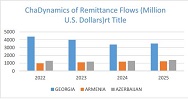
The article presents a comprehensive analysis of the impact of the Russo–Ukrainiane War on Georgia’s financial system. The study is based on macroeconomic and financial data from 2022–2025. It examines the dynamics of economic growth, the factors contributing to the appreciation of the Georgian lari, the increase in remittances, the profitability of the banking sector, inflationary pressures, and the response of monetary policy.
The paper concludes that Georgia’s financial stability during 2022–2025 was largely driven by temporary external inflows, which, in the long term, create risks of increased economic concentration and heightened geopolitical vulnerabilities.
Downloads
References
Council on Foreign Relations. (2023). The Russia-Ukraine war: Global implications. https://www.cfr.org
International Monetary Fund. (2022). Regional economic outlook. International Monetary Fund.
Kakhniashvili, N. (2022). Directions for improving the investment environment in Georgia. In Proceedings of the VII International Scientific Conference: Challenges of Globalization in Economics and Business (pp. 227–233). Ivane Javakhishvili Tbilisi State University Press.
Kakhniashvili, N., Barbakadze, K., & Kakashvili, N. (2025). Modern approaches to liquidity risk management in the context of technological transformation. In Proceedings of the International Scientific Conference: Georgia's Economic Security: Current Situation and Challenges (pp. 262–267). Ivane Javakhishvili Tbilisi State University Press.
Liu, T.-Y., & Lee, C.-C. (2025). Impacts of the Russia–Ukraine war on energy prices: Evidence from OECD countries. Policy Studies, 46(3), 460–492.
Ministry of Economy and Sustainable Development of Georgia. (n.d.). https://www.economy.ge
Ministry of Finance of Georgia. (n.d.). https://www.mof.ge
National Bank of Georgia. (2022). Annual report 2022.
National Bank of Georgia. (2023). Annual report 2023.
National Bank of Georgia. (2024). Annual report 2024.
National Bank of Georgia. (2025). Annual report 2025.
National Bank of Georgia. (n.d.). Financial stability reports.
National Statistics Office of Georgia (Geostat). (n.d.). https://www.geostat.ge
Parliamentary Budget Office of Georgia. (2024). Annual report 2024.
World Bank. (2023). Europe and Central Asia economic update. World Bank.
Downloads
Published
How to Cite
Issue
Section
License
Copyright (c) 2026 Georgian Scientists

This work is licensed under a Creative Commons Attribution-NonCommercial-NoDerivatives 4.0 International License.