
Chronic Endometritis: Histomorphologic Features and Plasma Cell Marker Correlation in Endometrial Curettage Specimens

Downloads




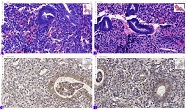
Chronic endometritis is a subtle inflammatory disorder of the endometrium characterized by stromal plasma-cell infiltration, the recognition of which remains challenging in routine histopathologic evaluation. The present study aimed to evaluate the histomorphologic features of chronic endometritis in endometrial curettage specimens and to assess their correlation with plasma-cell burden using CD138 and MUM1 immunohistochemistry. A retrospective analysis was performed on 40 endometrial curettage specimens. Histomorphologic features were assessed on hematoxylin-eosin sections, and plasma-cell infiltration was quantified using hotspot and average counts per 10 high-power fields for both CD138 and MUM1. Statistical analysis was performed using descriptive methods and Spearman correlation. The mean age of the cohort was 38.95 ± 8.64 years. Stromal edema, increased stromal cellularity, and surface epithelial changes were each present in 80.0% of cases, while periglandular inflammation, diffuse inflammation, and hemorrhage were observed in 60.0% of cases. All specimens demonstrated positivity for both CD138 and MUM1, with variable plasma-cell burden. A strong correlation was observed between CD138 and MUM1 average counts (ρ = 0.787, p < 0.001). Lymphoplasmacytic infiltrate showed the strongest association with plasma-cell burden (CD138: ρ = 0.866; MUM1: ρ = 0.884; p < 0.001). Periglandular and diffuse inflammation were also significantly associated with increased plasma-cell counts, whereas stromal edema did not demonstrate a significant correlation. These findings indicate that specific histomorphologic features, particularly lymphoplasmacytic infiltrate and gland-associated inflammation, are closely related to plasma-cell burden. Combined assessment using CD138 and MUM1 provides a consistent evaluation of plasma-cell infiltration and supports their complementary role in the diagnostic assessment of chronic endometritis.
Downloads
Kitaya K, Yasuo T. Immunohistochemistrical and Clinicopathological Characterization of Chronic Endometritis. American Journal of Reproductive Immunology [homepage on the Internet] 2011 [cited 2026 Apr 20];66(5):410–415. Available from: https://onlinelibrary.wiley.com/doi/10.1111/j.1600-0897.2011.01051.x
Kitaya K, Takeuchi T, Mizuta S, Matsubayashi H, Ishikawa T. Endometritis: new time, new concepts. Fertil Steril 2018;110(3):344–350.
Miguel RDV, Chivukula M, Krishnamurti U, et al. Limitations of the criteria used to diagnose histologic endometritis in epidemiologic pelvic inflammatory disease research. Pathol Res Pract 2011;207(11):680–685.
Kitaya K, Yasuo T, Yamaguchi T. Bridging the Diagnostic Gap between Histopathologic and Hysteroscopic Chronic Endometritis with Deep Learning Models. Medicina (B Aires) [homepage on the Internet] 2024 [cited 2026 Apr 20];60(6):972. Available from: https://www.mdpi.com/1648-9144/60/6/972
Kitaya K, Yasuo T, Yamaguchi T. Bridging the Diagnostic Gap between Histopathologic and Hysteroscopic Chronic Endometritis with Deep Learning Models. Medicina (Lithuania) 2024;60(6).
Miguel RDV, Chivukula M, Krishnamurti U, et al. Limitations of the criteria used to diagnose histologic endometritis in epidemiologic pelvic inflammatory disease research. Pathol Res Pract [homepage on the Internet] 2011 [cited 2026 Apr 20];207(11):680–685. Available from: https://linkinghub.elsevier.com/retrieve/pii/S0344033811002044
Li Y, Xu S, Yu S, et al. Diagnosis of chronic endometritis: How many CD138+ cells/HPF in endometrial stroma affect pregnancy outcome of infertile women? American Journal of Reproductive Immunology 2021;85(5).
Dang J, Xiao X, Li M. Correlation of hysteroscopic findings of chronic endometritis with CD138 immunohistochemistry and their correlation with pregnancy outcomes. J Assist Reprod Genet [homepage on the Internet] 2024 [cited 2026 Apr 20];41(9):2477–2483. Available from: https://link.springer.com/10.1007/s10815-024-03204-8
Dang J, Xiao X, Li M. Correlation of hysteroscopic findings of chronic endometritis with CD138 immunohistochemistry and their correlation with pregnancy outcomes. J Assist Reprod Genet 2024;41(9):2477–2483.
Falini B, Fizzotti M, Pucciarini A, et al. A monoclonal antibody (MUM1p) detects expression of the MUM1/IRF4 protein in a subset of germinal center B cells, plasma cells, and activated T cells. Blood 2000;95(6):2084–2092.
Falini B, Fizzotti M, Pucciarini A, et al. A monoclonal antibody (MUM1p) detects expression of the MUM1/IRF4 protein in a subset of germinal center B cells, plasma cells, and activated T cells. Blood [homepage on the Internet] 2000 [cited 2026 Apr 20];95(6):2084–2092. Available from: https://ashpublications.org/blood/article/95/6/2084/139568/A-monoclonal-antibody-MUM1p-detects-expression-of
Bayer-Garner IB, Korourian S. Plasma cells in chronic endometritis are easily identified when stained with syndecan-1. Modern Pathology 2001;14(9):877–879.
Bayer-Garner IB, Korourian S. Plasma Cells in Chronic Endometritis are Easily Identified When Stained with Syndecan-1. Modern Pathology [homepage on the Internet] 2001 [cited 2026 Apr 20];14(9):877–879. Available from: https://linkinghub.elsevier.com/retrieve/pii/S0893395222037061
Crum CP, Egawa K, Fenoglio CM, Richart RM. Chronic endometritis: The role of immunohistochemistry in the detection of plasma cells. Am J Obstet Gynecol 1983;147(7):812–815.
Crum CP, Egawa K, Fenoglio CM, Richart RM. Chronic endometritis: The role of immunohistochemistry in the detection of plasma cells. Am J Obstet Gynecol [homepage on the Internet] 1983 [cited 2026 Apr 20];147(7):812–815. Available from: https://linkinghub.elsevier.com/retrieve/pii/0002937883900455
Copyright (c) 2026 Georgian Scientists

This work is licensed under a Creative Commons Attribution-NonCommercial-NoDerivatives 4.0 International License.