Assessment of Pavement Condition and Application of the Pavement Condition Index in Road Network Evaluation

Downloads




This paper discusses modern approaches to road pavement condition assessment and examines the possibility of applying the Pavement Condition Index (PCI) in the evaluation of the road network in Georgia. Currently, pavement condition assessment mainly relies on visual inspection, measurement of the International Roughness Index (IRI), and evaluation of pavement structural capacity.
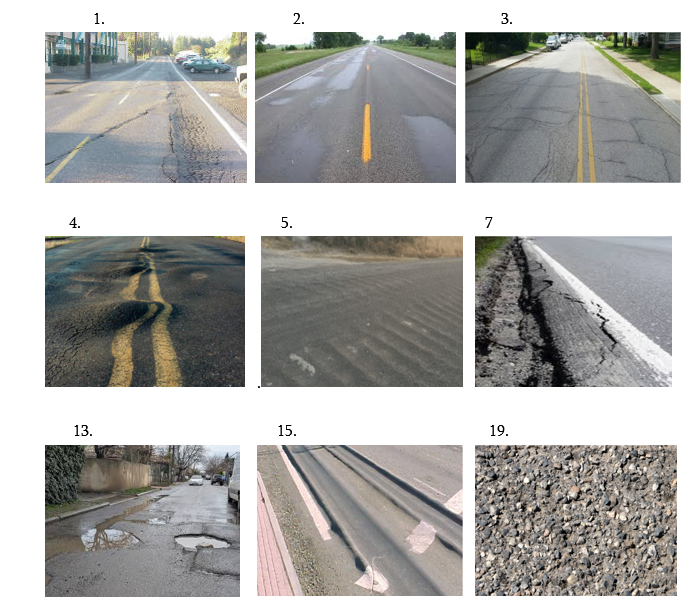
The study analyzes the classification of asphalt pavement distresses according to the PCI methodology and considers the potential adaptation of this method to local conditions. Several improvements are proposed, including the simplification of distress classification, exclusion of rarely occurring damages, and the inclusion of additional defects related to bridge structures.
The results indicate that the use of the PCI methodology significantly improves the efficiency of pavement condition assessment and facilitates decision-making processes in road infrastructure management systems.
Downloads
ASTM International. Standard Practice for Roads and Parking Lots Pavement Condition Index Surveys (ASTM D6433). West Conshohocken, PA: ASTM International, 2020.
Shahin, M. Y. Pavement Management for Airports, Roads, and Parking Lots. Boston: Springer, 2005.
Austroads. Guide to Pavement Technology Part 5: Pavement Evaluation. Sydney: Austroads, 2020.
Hall, Kathleen T., Corinne S. Sharpe, Steve M. Hudson, and W. Ronald Hudson. Pavement Management Systems. Washington, DC: Transportation Research Board, 2017.
Flintsch, Gerardo W., and M. I. Diefenderfer. Pavement Condition Assessment Technologies. Washington, DC: Transportation Research Board, 2018.
Papagiannakis, A. T., and Eyad Masad. Pavement Design and Materials. Hoboken, NJ: John Wiley & Sons, 2008.
Federal Highway Administration. Pavement Performance Measures and Management. Washington, DC: FHWA, 2019.
Huang, Yang H. Pavement Analysis and Design. 2nd ed. Upper Saddle River, NJ: Pearson Prentice Hall, 2004.
Copyright (c) 2026 Georgian Scientists

This work is licensed under a Creative Commons Attribution-NonCommercial-NoDerivatives 4.0 International License.