
The Role of Probiotics and Prebiotics in the Management of MASLD: A Clinical Perspective

Downloads




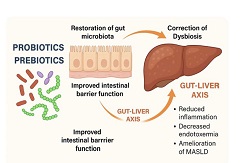
Background: Metabolic dysfunction-associated steatotic liver disease (MASLD) is a global health burden linked to metabolic syndrome and gut microbiota dysbiosis. Recent studies suggest that probiotics and prebiotics may play a pivotal role in modifying gut microbiota and improving liver outcomes in MASLD. Gut microbiota modulation with probiotics and prebiotics is emerging as a promising intervention.
Objective: To assess the clinical impact of probiotic-prebiotic therapy on liver function in MASLD patients.
Methods: A prospective observational study was conducted on 85 patients with MASLD. Participants received a standardized combination of probiotics (Lactobacillus rhamnosus GG and Bifidobacterium longum) and prebiotics (inulin and fructooligosaccharides) for 12 weeks. Liver function tests (LFTs) including ALT, AST, and GGT were measured before and after treatment.
Results: After 12 weeks, significant reductions were observed in ALT (mean reduction: 18.5 U/L, p<0.001), AST (mean reduction: 12.3 U/L, p=0.002), and GGT (mean reduction: 15.2 U/L, p=0.005). 64.7% of patients achieved normalization of at least one elevated liver enzyme. No serious adverse events were reported.
Conclusion: This study provides evidence that short-term probiotic-prebiotic therapy improves liver biochemistry in MASLD patients, supporting gut microbiota modulation as an adjunctive strategy in MASLD management.
Downloads
Alisi A, et al. Gut microbiota and NAFLD: pathogenesis and therapeutic implication. Acta Paediatr. 2014;103(1):18–27.
Ma YY, et al. Probiotics improve liver enzymes in NAFLD: a meta-analysis. World J Gastroenterol. 2019;25(23):2868–2879.
Zhu L, et al. Probiotics and prebiotics in NAFLD treatment: systematic review. Clin Nutr. 2022;41(1):225–234.
Le Roy T, et al. Gut microbiota composition and metabolism are associated with liver steatosis and fibrosis in NAFLD. Cell Metab. 2019;29(4):875–882.
Boursier J, et al. The severity of NAFLD is associated with gut dysbiosis and shift in the metabolic function of the gut microbiota. Hepatology. 2016;63(3):764–775.
Aron-Wisnewsky J, et al. Gut microbiota and human NAFLD: disentangling microbial signatures from metabolic disorders. Nat Rev Gastroenterol Hepatol. 2020;17(5):279–297.
Tilg H, et al. NAFLD and the gut-liver axis: Pathophysiological concepts and clinical implications. Nat Rev Gastroenterol Hepatol. 2021;18(7):497–515.
Safari Z, Gerard P. The links between the gut microbiome and non-alcoholic fatty liver disease (NAFLD). Cell Mol Life Sci. 2019;76(8):1541–1558.
De Minicis S, et al. Dysbiosis contributes to fibrogenesis in the course of chronic liver injury in mice. Hepatology. 2014;59(5):1738–1749.
Jiang W, et al. Dysbiosis gut microbiota associated with inflammation and impaired mucosal immune function in intestine of humans with NAFLD. Sci Rep. 2015;5:8096.
Miele L, et al. Increased intestinal permeability and tight junction alterations in NAFLD. Hepatology. 2009;49(6):1877–1887.
Chiu CN, et al. The role of probiotics in NAFLD: A meta-analysis and systematic review. Clin Res Hepatol Gastroenterol. 2021;45(4):101626.
Shen F, et al. Gut microbiota dysbiosis in patients with non-alcoholic fatty liver disease. Hepatobiliary Pancreat Dis Int. 2017;16(4):375–381.
Del Chierico F, et al. Gut microbiota profiling of pediatric NAFLD and obese patients: an observational pilot study. Hepatology. 2017;65(2):451–464.
Abenavoli L, et al. The role of prebiotics and probiotics in NAFLD. Curr Pharm Des. 2020;26(30):3632–3637.
Salazar N, et al. Inulin-type prebiotics modulate intestinal Bifidobacterium species populations and impact on serum lipids. Am J Clin Nutr. 2011;93(4):622–631.
Eslam M, et al. A new definition for metabolic dysfunction-associated fatty liver disease: An international expert consensus statement. J Hepatol. 2020;73(1):202–209.
Yan AW, et al. The intestinal microbiome and liver disease. J Gastroenterol Hepatol. 2011;26(Suppl 1):10–15.
Machado MV, Cortez-Pinto H. Diet, microbiota, obesity, and NAFLD: a dangerous quartet. Gut Microbes. 2014;5(4):409–415.
Kobyliak N, et al. Probiotics and synbiotics improve lipid profile in dyslipidemic patients: A meta-analysis. Crit Rev Food Sci Nutr. 2018;58(4):640–657.
Malaguarnera M, et al. Bifidobacterium longum with fructo-oligosaccharides in patients with NAFLD: A randomized, double-blind, placebo-controlled study. Dig Dis Sci. 2012;57(2):545–553.
Qin N, et al. Alterations of the human gut microbiome in liver cirrhosis. Nature. 2014;513(7516):59–64.
Wong VW, et al. The role of gut microbiota in NAFLD. Nat Rev Gastroenterol Hepatol. 2015;12(7):388–400.
Yao Y, et al. A metabolomics-based investigation of the effects of a probiotic supplement on liver fat in NAFLD. Nutrients. 2023;15(3):715.
Copyright (c) 2025 Georgian Scientists

This work is licensed under a Creative Commons Attribution-NonCommercial-NoDerivatives 4.0 International License.