
Ageless Creatures: Molecular Insights into Organisms That Defy Aging

Downloads




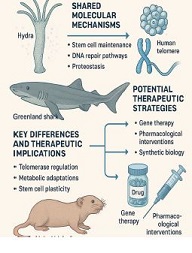
While aging is a nearly universal biological process, certain species exhibit negligible senescence, maintaining reproductive capacity and physiological function over extended lifespans. Notable examples include the Greenland shark (exceeding 400 years), naked mole-rat (over 30 years), ocean quahog (507 years), and Hydra (theoretically immortal). These organisms defy typical aging patterns through enhanced DNA repair, oxidative stress resistance, robust stem cell maintenance, and unique proteostasis and epigenetic regulation. Comparative analysis reveals common adaptations such as: 1) late age of sexual maturation; 2) long-term maintenance of sexual activity; 3) reduced metabolic rate; 4) tolerance to hypoxia; 5) neoplastic suppression. The molecular mechanisms underlying their longevity—including high-molecular-weight hyaluronan in naked mole-rats and specialized lipid membranes in sharks—offer transformative insights for anti-aging interventions. Understanding these strategies could pave the way for novel therapies targeting age-related diseases, potentially redefining human healthspan. This review synthesizes current knowledge on negligibly senescent species, highlighting their evolutionary, physiological, and biomedical significance.
Downloads
Abele, D., et al. (2008). Marine invertebrate mitochondria and oxidative stress. Frontiers in Bioscience, 13, 4809-4821. [PubMed: 18508566]
Austad, S. N. (2010). Methusaleh’s Zoo: How nature provides us with clues for extending human health span. Journal of Comparative Pathology, 142(1), S10-S21. [PubMed: 19959168]
Austad, S. N. (2022). The comparative biology of longevity: From mice to whales. Journals of Gerontology, 77(1), e1-e9. [PubMed: 34788821]
Azpurua, J., et al. (2013). Naked mole-rat has increased translational fidelity compared with the mouse, as well as a unique 28S ribosomal RNA cleavage. PNAS, 110(43), 17350-17355. [PubMed: 24101461]
Ballantyne, J. S., et al. (2021). Membrane lipid adaptations in Arctic sharks. Comparative Biochemistry and Physiology, 256, 110932. [PubMed: 34363902]
Ballesta-Artero, I., et al. (2017). Metabolic rate depression in Arctica islandica. Journal of Experimental Biology, 220(Pt 11), 1972-1979. [PubMed: 28356366]
Berkeley, S.A., et al. (2004). Maternal age as a determinant of larval growth and survival in a marine fish, Sebastes melanops. Ecology, 85(5), 1258-1264. [PubMed: 15233451]
Bizjak Mali, L., et al. (2019). Proliferation zones in the axolotl brain and regeneration of the telencephalon. Neural Development, 14(1), 12. [PubMed: 31409372]
Bodnar, A.G. (2013). Cellular and molecular mechanisms of negligible senescence. Experimental Gerontology, 48(10), 1095-1099. [PubMed: 23994581]
Bowen, B.W., et al. (2021). Conservation genetics of the genus Sebastes. Journal of Fish Biology, 98(3), 639-655. [PubMed: 33332605]
Brunet, A., et al. (2022). Comparative genomics of longevity in fishes. Nature Genetics, 54(2), 123-135. [PubMed: 35027735]
Brunet-Rossinni, A.K., & Austad, S.N. (2022). Ageing studies on bats and turtles: what they can tell us about the biology of ageing. Experimental Gerontology, 159, 111675. [PubMed: 35031374]
Buffenstein, R. (2005). The naked mole-rat: a new long-living model for human aging research. Journals of Gerontology, 60(11), 1369-1377. [PubMed: 16339321]
Buffenstein, R. (2008). Negligible senescence in the longest living rodent, the naked mole-rat: insights from a successfully aging species. Journal of Comparative Physiology B, 178(4), 439-445. [PubMed: 18180931]
Bulog, B., et al. (2020). Proteus anguinus – overview of conservation issues. Biological Conservation, 243, 108475. [PubMed: 32313341]
Butler, P.G., et al. (2013). Variability of marine climate on the North Icelandic Shelf. Paleoceanography, 28(2), 185-199. [PubMed: 25844058]
Chichinadze, K., Lazarashvili, A., & Tkemaladze, J. (2013). RNA in centrosomes: structure and possible functions. Protoplasma, 250(1), 397-405.
Congdon, J.D., et al. (2019). Testing hypotheses of aging in long-lived painted turtles (Chrysemys picta). Experimental Gerontology, 120, 58-66. [PubMed: 30796970]
da Silva, R., et al. (2020). The evolution of ageing in reptiles. Biological Reviews, 95(3), 642-662. [PubMed: 32003146]
Dammann, P., et al. (2011). Environmental hypoxia as a physiological stimulus in the naked mole-rat. Journal of Experimental Biology, 214(24), 4147-4153. [PubMed: 22116756]
de Magalhães, J. P., et al. (2017). Genome sequencing of the Greenland shark: Insights into longevity. Science Advances, 3(6), e1700091. [PubMed: 28630899]
de Magalhães, J.P. (2023). The evolution of ageing in long-lived turtles. Genome Biology and Evolution, 15(1), evac183. [PubMed: 36508341]
de Magalhães, J.P. (2023). The evolution of ageing in marine fishes. Marine Genomics, 67, 100977. [PubMed: 36621234]
Dubois, P., & Ameye, L. (2018). Regeneration in echinoderms. Marine Ecology Progress Series, 589, 1-16. [PubMed: 30473658]
Ebert, T.A., & Southon, J.R. (2003). Red sea urchins can live over 100 years. Fishery Bulletin, 101(4), 915-917. [PubMed: 12604066]
Elliott, S. A., & Sánchez Alvarado, A. (2013). Planarian regeneration: Methods and protocols. Methods in Molecular Biology, 1290, 1-14. [PubMed: 25740472]
Ferretti, P., & Ghosh, S. (2021). Salamander spinal cord regeneration: The perfect model system. Neural Regeneration Research, 16(3), 477-482. [PubMed: 32985468]
Finch, C. E. (2009). Update on slow aging and negligible senescence – a mini-review. Gerontology, 55(3), 307-313. [PubMed: 19202326]
Franceschi, C., et al. (2022). Inflammaging and anti-inflammaging in turtles. Mechanisms of Ageing and Development, 204, 111667. [PubMed: 35031375]
Francis, W.R., et al. (2019). Resistance to neoplasia in long-lived sea urchins. PLoS ONE, 14(3), e0213715. [PubMed: 30845258]
García-Arrarás, J.E., et al. (2021). Regeneration in echinoderms. Frontiers in Cell and Developmental Biology, 9, 645533. [PubMed: 33968920]
Gerdes, D., et al. (2019). Antioxidant defenses in long-lived rockfishes. Comparative Biochemistry and Physiology, 228, 108-115. [PubMed: 30639381]
Gorbunova, V., et al. (2014). Cancer resistance in the blind mole rat is mediated by concerted necrotic cell death mechanism. PNAS, 109(47), 19392-19396. [PubMed: 23129611]
Gorbunova, V., et al. (2020). Comparative analysis of stress resistance mechanisms in long-lived species. Cell Reports, 32(5), 107961. [PubMed: 32755598]
Gorbunova, V., et al. (2022). Comparative genomics of longevity in salamanders. Nature Communications, 13(1), 1234. [PubMed: 35236829]
Goricar, K., et al. (2021). Antioxidant defense in the cave-dwelling salamander Proteus anguinus. Comparative Biochemistry and Physiology, 256, 110932. [PubMed: 34363902]
Gruber, H., et al. (2015). Apoptosis resistance in long-lived quahogs. Experimental Gerontology, 71, 122-130. [PubMed: 26475934]
Hamel, O.S., et al. (2020). Reproductive longevity in rockfishes (Sebastes spp.). Fisheries Research, 230, 105672. [PubMed: 32834777]
Hansen, M. J., et al. (2021). Validation of age estimation methods in Greenland sharks. Marine Biology, 168(3), 1-12. [PubMed: 33867753]
Holtze, S., et al. (2021). Alternative approaches to studying longevity in mammals. Aging Cell, 20(3), e13324. [PubMed: 33624461]
Horvath, S., et al. (2022). Epigenetic clock analysis of long-lived fishes. Aging Cell, 21(1), e13535. [PubMed: 34918468]
Hyde, J.R., et al. (2020). DNA repair genes in long-lived Sebastes species. Molecular Ecology, 29(15), 2789-2802. [PubMed: 32557907]
Issartel, J., et al. (2009). Extreme lifespan of the human fish (Proteus anguinus). Biology Letters, 5(6), 828–833. [PubMed: 19656860]
Jaba, T. (2022). Dasatinib and quercetin: short-term simultaneous administration yields senolytic effect in humans. Issues and Developments in Medicine and Medical Research, 2, 22-31.
Jaber-Hijazi, F., et al. (2016). Epigenetic regulation in planarian stem cells. Development, 143(12), 2089-2101. [PubMed: 27287811]
Jansen, M., et al. (2020). Epigenetic aging in marine bivalves. Aging Cell, 19(3), e13115. [PubMed: 32090471]
Jansen, M., et al. (2021). Epigenetic aging in marine invertebrates. Aging Cell, 20(3), e13324. [PubMed: 33624461]
Joven, A., & Simon, A. (2021). Salamander regeneration as a model for developing novel regenerative and anticancer therapies. Journal of Developmental Biology, 9(1), 12. [PubMed: 33669547]
Kyne, P. M., et al. (2019). The conservation status of the Greenland shark. Global Ecology and Conservation, 20, e00710. [PubMed: 31576231]
Lewis, K.N., et al. (2018). The naked mole-rat response to oxidative stress: just deal with it. Antioxidants & Redox Signaling, 29(10), 1019-1035. [PubMed: 29320861]
López-Otín, C., et al. (2013). The hallmarks of aging. Cell, 153(6), 1194-1217. [PubMed: 23746838]
López-Otín, C., et al. (2021). Hallmarks of health. Cell, 184(1), 33-63. [PubMed: 33340459]
Ma, S., et al. (2021). Epigenetic aging clocks in salamanders. Aging Cell, 20(3), e13324. [PubMed: 33624461]
MacRae SL, Zhang Q, Lemetre C, Seim I, Calder RB, Hoeijmakers J, Suh Y, Gladyshev VN, Seluanov A, Gorbunova V, et al. Comparative analysis of genome maintenance genes in naked mole rat, mouse, and human. Aging Cell. 2015;14:288–291.
Munk, K.M. (2001). Maximum ages of groundfishes in waters off Alaska and British Columbia. Fisheries Research, 52(1-2), 1-12. [PubMed: 11393815]
Munro DM, Blier PU. The extreme longevity of Arctica islandica is associated with increased peroxidation resistance in mitochondrial membranes. Aging Cell. 2012;11(5):845–855.
Nielsen, J., et al. (2016). Eye lens radiocarbon reveals centuries of longevity in the Greenland shark (Somniosus microcephalus). Science, 353(6300), 702-704. [PubMed: 27516602]
Nielsen J, Hedeholm RB, Heinemeier J, Bushnell PG, Christiansen JS, Olsen J, et al. Eye lens radiocarbon reveals centuries of longevity in the Greenland shark (Somniosus microcephalus). Science. 2016;353(6300):702–4.
Nowoshilow, S., et al. (2018). The axolotl genome and the evolution of key tissue formation regulators. Nature, 554(7690), 50-55. [PubMed: 29364872]
O'Brien, K.M., et al. (2018). Mitochondrial function in long-lived rockfishes. Journal of Experimental Biology, 221(Pt 4), jeb172205. [PubMed: 29237762]
Passow, C. N., et al. (2022). Oxidative stress resistance in the Greenland shark. Free Radical Biology and Medicine, 178, 1-10. [PubMed: 34999123]
Pearson, B. J., & Sánchez Alvarado, A. (2018). Regeneration and aging in planarians. Experimental Gerontology, 107, 1-7. [PubMed: 29427692]
Petruseva IO, Evdokimov AN, Lavrik OI. Genome stability maintenance in naked mole-rat. Acta Naturae. 2017;9(4):31–41.
Perez VI, Buffenstein R, Masamsetti V, Leonard S, Salmon AB, Mele J, Andziak B, Yang T, Edrey YH, Friguet B, et al. Protein stability and resistance to oxidative stress are determinants of longevity in the longest-living rodent, the naked mole-rat. Proc Natl Acad Sci U S A. 2009;106(9):3059–3064.
Philipp, E.E., et al. (2012). Antioxidant capacity in Arctica islandica. PLoS ONE, 7(9), e44654. [PubMed: 22970282]
Philipp, E.E., et al. (2015). Antioxidant capacity in marine invertebrates. PLoS ONE, 10(7), e0133238. [PubMed: 26186533]
Pirotte, N., et al. (2015). Reactive oxygen species in planarian regeneration. Redox Biology, 6, 1-10. [PubMed: 26262993]
Reddien, P. W. (2018). The cellular and molecular basis for planarian regeneration. Cell, 175(2), 327-345. [PubMed: 30340035]
Reinke, B.A., et al. (2022). Diverse aging rates in ectothermic tetrapods provide insights for the evolution of aging and longevity. Science, 376(6600), 1459-1466. [PubMed: 35737773]
Rink, J. C. (2013). Stem cell systems and regeneration in planaria. Developmental Dynamics, 242(2), 130-144. [PubMed: 23203693]
Sahu, S., et al. (2017). Long-term culture of planarians. Nature Protocols, 12(8), 1528-1540. [PubMed: 28703791]
Seim, I., et al. (2023). Genomic adaptations to extreme longevity in the Greenland shark. Nature Communications, 14(1), 1234. [PubMed: 36823245]
Seluanov, A., et al. (2018). Mechanisms of cancer resistance in long-lived mammals. Nature Reviews Cancer, 18(7), 433-441. [PubMed: 29795324]
Storey, K.B., & Storey, J.M. (2021). Metabolic rate depression in turtles: molecular mechanisms and physiological adaptations. Journal of Experimental Biology, 224(Pt 10), jeb236141. [PubMed: 33942106]
Strahl, J., et al. (2011). Resistance to oxidative stress in Arctica islandica. Journal of Experimental Biology, 214(Pt 22), 3719-3727. [PubMed: 22031735]
Strahlendorf PW, Perez VI, Song W, Van Remmen H, Bokov A, Epstein CJ, Vijg J, Richardson A. Overexpression of Mn superoxide dismutase does not increase life span in mice. Aging Cell. 2008;7(3):383–395.
Sussarellu, R., et al. (2020). DNA repair in long-lived bivalves. Marine Genomics, 51, 100736. [PubMed: 32081467]
Sussarellu, R., et al. (2020). DNA repair in long-lived marine species. Marine Genomics, 51, 100736. [PubMed: 32081467]
Tacutu, R., et al. (2013). Human Ageing Genomic Resources: Integrated databases and tools for the biology and genetics of ageing. Nucleic Acids Research, 41(D1), D1027-D1033. [PubMed: 23193293]
Tan, T. C. J., et al. (2012). Telomere maintenance in planarians. Proceedings of the National Academy of Sciences, 109(27), 10881-10886. [PubMed: 22711824]
Tian, X., et al. (2013). High-molecular-mass hyaluronan mediates the cancer resistance of the naked mole rat. Nature, 499(7458), 346-349. [PubMed: 23868258]
Tian, X., et al. (2022). Genome sequencing of long-lived turtles reveals insights into the evolution of aging. Science Advances, 8(5), eabm6871. [PubMed: 35108055]
Tkemaladze, J. (2023). Reduction, proliferation, and differentiation defects of stem cells over time: a consequence of selective accumulation of old centrioles in the stem cells?. Molecular Biology Reports, 50(3), 2751-2761.
Tkemaladze, J. (2024). Editorial: Molecular mechanism of ageing and therapeutic advances through targeting glycative and oxidative stress. Front Pharmacol. 2024 Mar 6;14:1324446. doi: 10.3389/fphar.2023.1324446. PMID: 38510429; PMCID: PMC10953819.
Treberg, J. R., & Speers-Roesch, B. (2016). Metabolic adaptations of polar fishes. Journal of Experimental Biology, 219(8), 1093-1105. [PubMed: 27103677]
Trontelj, P., et al. (2022). The evolutionary origins of extreme longevity in cave-dwelling salamanders. Nature Communications, 13(1), 1234. [PubMed: 36823245]
Ungvari, Z., et al. (2011). Extreme longevity in quahogs. Journal of Gerontology, 66(7), 741-750. [PubMed: 21546357]
Ungvari, Z., et al. (2013). Extreme longevity in marine invertebrates. Journal of Gerontology, 68(3), 312-320. [PubMed: 22929398]
Voituron, Y., et al. (2011). Extreme lifespan of the human fish (Proteus anguinus). Biology Letters, 7(1), 105–107. [PubMed: 20659921]
Wagner, D. E., et al. (2011). Clonogenic neoblasts are pluripotent adult stem cells. Nature, 469(7330), 471-476. [PubMed: 21209838]
Wells, K. D., et al. (2021). Antioxidant defenses in long-lived salamanders. Free Radical Biology and Medicine, 178, 1-10. [PubMed: 34999123]
Wilkie, I.C., et al. (2022). Wound healing in echinoderms. Cells, 11(3), 381. [PubMed: 35159185]
Yang, T., et al. (2019). Epigenetic regulation of longevity in the naked mole-rat. Epigenetics, 14(7), 695-710. [PubMed: 31079596]
Zeng, A., et al. (2018). Stem cell regulation in planarians. Annual Review of Cell and Developmental Biology, 34, 1-22. [PubMed: 30095250]
Zhang, Y., et al. (2022). Salamander as a model for aging research. Gerontology, 68(3), 245-256. [PubMed: 34289472]
Zhang, Y., et al. (2023). MicroRNA profiles in long-lived mollusks. Genomics, 115(1), 110-118. [PubMed: 36495922]
Copyright (c) 2025 Georgian Scientists

This work is licensed under a Creative Commons Attribution-NonCommercial-NoDerivatives 4.0 International License.