
Acquisition of Hard-to-detect Objects in Airspace, Utilizing Modulated Laser Radiation for Perimeter Control

Downloads




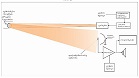
The paper presents studies designed to create a detector device for objects that are difficult to detect in airspace by radar. The principle of operation of the device is based on the use of modulated laser radiation. In particular, a 10 W laser with a wavelength of 980 (+/-5) nm was used in the studies. The studies were mainly devoted to the extent to which the quality of the received signal depends on the pulse filling capacity of the transverse pulse control signal in laser modulation. The experiment was conducted for transverse pulses of the modulator with a filling capacity of 90% to 10%. Both the modulated signal and the signal reflected from the object were recorded with an oscilloscope.
The studies showed that the quality of the signal reflected from the object does not deteriorate with a decrease in filling capacity and it is quite good even in the case of a filling capacity of 10%. This fact was also confirmed when recording the signal reflected from the object with a headset. This leads to the conclusion that reducing the pulse fill factor to 10-15% by using a transverse pulse control signal in the modulation will allow us to increase the factory-allowed power of the laser by 2-3 times, and it will be possible to receive signals from quite large distances (hundreds of meters) and, accordingly, detect objects.
Downloads
Е. В. Медведев, Д. С. Бурый, С. А. Гулин, В. Г. Страдинь, Р. В. Чумарин . Светоэнергетический расчет оптико-электронной аппаратуры дистанционного зондирования Земли видимого диапазона. Вестник Военного инновационного технополиса «ЭРА», 2023, T. 4, № 1, стр. 72-77.
Жуков Г.В. ВЛИЯНИЕ ПОГЛОЩЕНИЯ СВЕТА В ЗЕМНОЙ АТМОСФЕРЕ НА ФОТОМЕТРИЧЕСКИЕ НАБЛЮДЕНИЯ ЗВЕЗД. Учебно-методическое пособие. Казань, 2010, - 17с.
Copyright (c) 2025 Georgian Scientists

This work is licensed under a Creative Commons Attribution-NonCommercial-NoDerivatives 4.0 International License.