Features of Immunohistochemical Expression of Melatonin MT1 Receptor in Epithelial Ovarian Tumors

Downloads




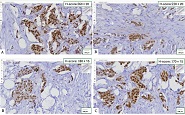
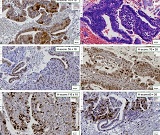
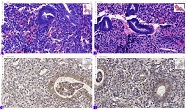
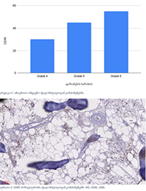
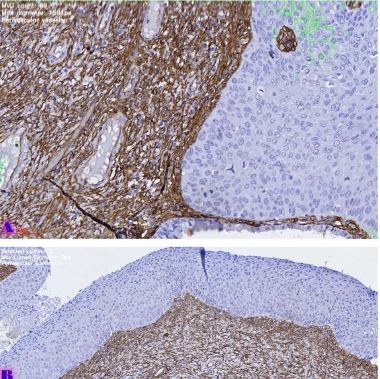
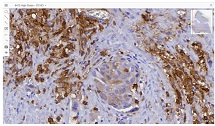
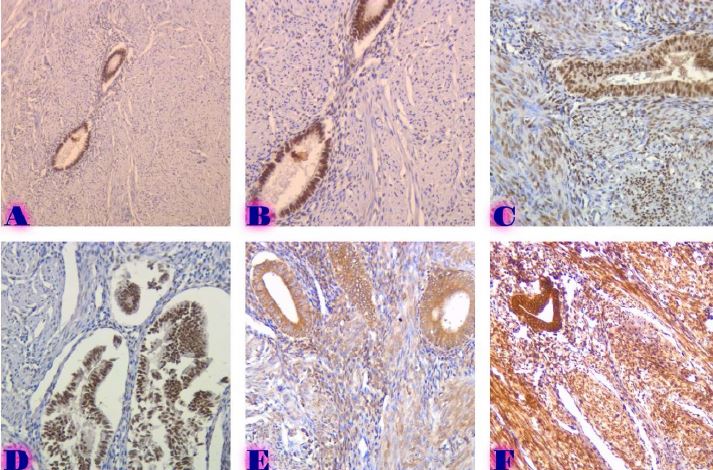
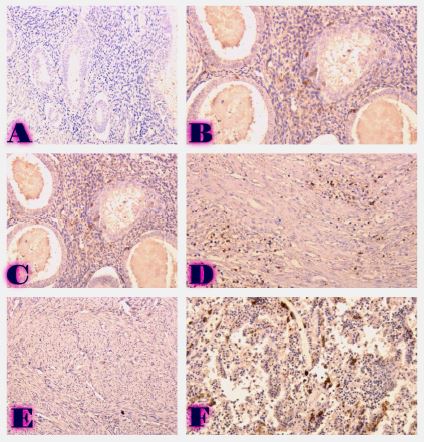
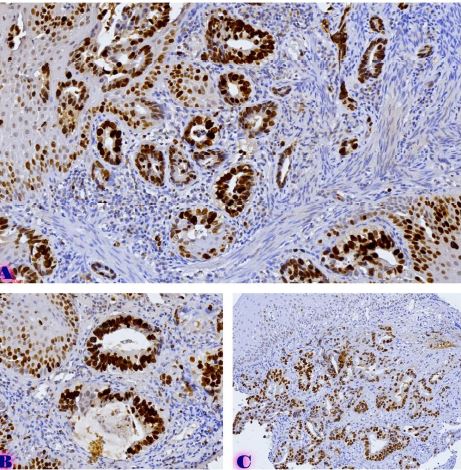
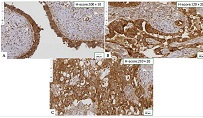
Melatonin exerts multiple biological effects through its membrane receptors, particularly Melatonin Receptor 1 (MT1), which has been implicated in the regulation of cellular proliferation, apoptosis, oxidative stress, and tumour progression. However, the expression profile of MT1 in ovarian epithelial tumours remains insufficiently characterised. To investigate the immunohistochemical expression of MT1 in ovarian epithelial tumors and evaluate its distribution across different histological subtypes and stages of tumor progression. A retrospective immunohistochemical study was performed on ovarian epithelial tissue specimens representing normal ovarian surface epithelium, benign serous cystadenoma, serous borderline tumour, low-grade serous carcinoma, high-grade serous carcinoma, and endometrioid carcinoma. MT1 expression was assessed using immunohistochemistry and quantified by H-score methodology based on staining intensity and the percentage of positive tumour cells. MT1 expression was detected in all examined groups but demonstrated substantial heterogeneity among histological subtypes. Normal ovarian epithelium showed low expression, while benign serous cystadenomas and serous borderline tumours demonstrated moderate expression. The highest MT1 expression was observed in high-grade serous carcinoma, whereas endometrioid carcinoma exhibited the lowest expression levels. MT1 expression was therefore not associated with a gradual decrease during malignant transformation but rather displayed a subtype-specific distribution pattern.
MT1 expression in ovarian epithelial tumours is characterised by significant histological heterogeneity. High-grade serous carcinoma demonstrates marked MT1 overexpression compared with other epithelial ovarian tumour subtypes. These findings suggest that MT1 may be associated with subtype-specific biological mechanisms rather than serving as a simple marker of tumour progression.
Downloads
Cancer Genome Atlas Research Network. Integrated genomic analyses of ovarian carcinoma. Nature 2011;474:609–15. https://doi.org/10.1038/nature10166.
Kipiani N, Kharaishvili M, Bokhua Z, Burkadze G, Kepuladze S. Features of Melatonin Receptor Expression in Endometrial Precancerous and Neoplastic Processes. Georgian Scientists 2026;8:227–39. https://doi.org/10.52340/gs.2026.08.01.21.
Ricciardi E, Baert T, Ataseven B, Heitz F, Prader S, Bommert M, et al. Low-grade Serous Ovarian Carcinoma. Geburtshilfe Frauenheilkd 2018;78:972–6. https://doi.org/10.1055/a-0717-5411.
Linowiecka K, Slominski AT, Reiter RJ, Böhm M, Steinbrink K, Paus R, et al. Melatonin: A Potential Regulator of DNA Methylation. Antioxidants 2023;12. https://doi.org/10.3390/ANTIOX12061155.
Dubocovich ML, Markowska M. Functional MT1 and MT2 melatonin receptors in mammals. Endocrine 2005;27:101–10. https://doi.org/10.1385/ENDO:27:2:101.
Liu J, Clough SJ, Hutchinson AJ, Adamah-Biassi EB, Popovska-Gorevski M, Dubocovich ML. MT1 and MT2 Melatonin Receptors: A Therapeutic Perspective. Annu Rev Pharmacol Toxicol 2016;56:361–83. https://doi.org/10.1146/ANNUREV-PHARMTOX-010814-124742.
Yuan L, Collins AR, Dai J, Dubocovich ML, Hill SM. MT1 melatonin receptor overexpression enhances the growth suppressive effect of melatonin in human breast cancer cells. Mol Cell Endocrinol 2002;192:147–56. https://doi.org/10.1016/S0303-7207(02)00029-1.
Lai L, Yuan L, Cheng Q, Dong C, Mao L, Hill SM. Alteration of the MT1 melatonin receptor gene and its expression in primary human breast tumors and breast cancer cell lines. Breast Cancer Res Treat 2009;118:293–305. https://doi.org/10.1007/S10549-008-0220-1.
Ram PT, Dai J, Yuan L, Dong C, Kiefer TL, Lai L, et al. Involvement of the mt1 melatonin receptor in human breast cancer. Cancer Lett 2002;179:141–50. https://doi.org/10.1016/S0304-3835(01)00873-4.
Collins A, Yuan L, Kiefer TL, Cheng Q, Lai L, Hill SM. Overexpression of the MT1 melatonin receptor in MCF-7 human breast cancer cells inhibits mammary tumor formation in nude mice. Cancer Lett 2003;189:49–57. https://doi.org/10.1016/S0304-3835(02)00502-5.
González A, Martínez-Campa C, Mediavilla MD, Alonso-González C, Sánchez-Mateos S, Hill SM, et al. Effects of MT1 melatonin receptor overexpression on the aromatase-suppressive effect of melatonin in MCF-7 human breast cancer cells. Oncol Rep 2007;17:947–53. https://doi.org/10.3892/OR.17.4.947.
Kadekaro AL, Andrade LNS, Floeter-Winter LM, Rollag MD, Virador V, Vieira W, et al. MT-1 melatonin receptor expression increases the antiproliferative effect of melatonin on S-91 murine melanoma cells. J Pineal Res 2004;36:204–11. https://doi.org/10.1111/J.1600-079X.2004.00119.X.
Copyright (c) 2026 Georgian Scientists

This work is licensed under a Creative Commons Attribution-NonCommercial-NoDerivatives 4.0 International License.