
Eye-Tracking Emotional and Spiritual Responses in Bilinguals: A Comparative Study of Georgian and Arabic Speakers

Загрузки




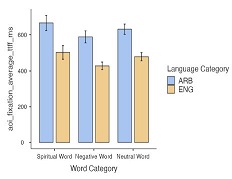
This study examined how bilingual speakers of Georgian-English and Arabic-English process emotional and spiritual language across their first (L1) and second (L2) languages using eye-tracking methodology. Participants viewed a series of emotionally neutral, negative, and spiritually themed words and sentences presented in both L1 and L2. Eye-tracking measures, including fixation duration, time to first fixation (TTFF), revisit counts, and total gaze time, were analyzed to assess cognitive and emotional engagement with the stimuli. Data from 35 participants (17 Georgian-English and 18 Arabic-English bilinguals) revealed that participants generally exhibited longer fixation durations and greater total gaze time when reading in English (L2), indicating increased cognitive load. However, spiritually themed content elicited longer fixations and higher gaze time in L1, suggesting deeper emotional and cultural resonance. TTFF was faster in L2 for both groups, though Arabic participants showed slower TTFF for spiritual content in Arabic, implying reflective processing. These findings support theories of emotional grounding in L1 and offer implications for multilingual education, therapy, and cross-cultural communication. Cultural and design limitations are acknowledged, with recommendations for incorporating religiosity measures and standardized stimuli in future research.
Скачивания
Adult Attachment Scale (AAS). (n.d.). Statistics Solutions. Retrieved 17 February 2025, from https://www.statisticssolutions.com/free-resources/directory-of-survey-instruments/adult-attachment-scale-aas/
A Psychological Measure of Islamic Religiousness: Development and Evidence for Reliability and Validity. (n.d.). Retrieved 9 May 2025, from https://www.researchgate.net/publication/248941665_A_Psychological_Measure_of_Islamic_Religiousness_Development_and_Evidence_for_Reliability_and_Validity
Construal-level theory of psychological distance. (n.d.). Retrieved 25 March 2025, from https://psycnet.apa.org/record/2010-06891-005
Cousins, K. A., Ash, S., Irwin, D. J., & Grossman, M. (2017). Dissociable substrates underlie the production of abstract and concrete nouns. Brain and Language, 165, 45–54. https://doi.org/10.1016/j.bandl.2016.11.003
Creswell, J. D., Way, B. M., Eisenberger, N. I., & Lieberman, M. D. (2007). Neural Correlates of Dispositional Mindfulness During Affect Labeling. Psychosomatic Medicine, 69(6), 560–565. https://doi.org/10.1097/PSY.0b013e3180f6171f
El-Dakhs, D. A., Sonbul, S., & Altarriba, J. (2023). How do foreign language learners process L2 emotion words in silent reading? an eye-tracking study. Languages, 8(2), 125. https://doi.org/10.3390/languages8020125
Harris, C. L., Gleason, J. B., & Ayçiçeǧi, A. (2006). 10. When is a First Language More Emotional? Psychophysiological Evidence from Bilingual Speakers. In A. Pavlenko (Ed.), Bilingual Minds (pp. 257–283). Multilingual Matters. https://doi.org/10.21832/9781853598746-012
LexTALE. (n.d.). Retrieved 9 May 2025, from https://www.lextale.com/whatislextale.html
Lindquist, K. A., MacCormack, J. K., & Shablack, H. (2015). The role of language in emotion: Predictions from psychological constructionism. Frontiers in Psychology, 6. https://doi.org/10.3389/fpsyg.2015.00444
Miller, G. A. (1990). The Place of Language in a Scientific Psychology. Psychological Science, 1(1), 7–14. https://doi.org/10.1111/j.1467-9280.1990.tb00059.x
Mortillaro, M., & Dukes, D. (2018). Jumping for Joy: The Importance of the Body and of Dynamics in the Expression and Recognition of Positive Emotions. Frontiers in Psychology, 9. https://doi.org/10.3389/fpsyg.2018.00763
Moseley, R., Carota, F., Hauk, O., Mohr, B., & Pulvermüller, F. (2012). A Role for the Motor System in Binding Abstract Emotional Meaning. Cerebral Cortex (New York, NY), 22(7), 1634–1647. https://doi.org/10.1093/cercor/bhr238
Nook, E. C., Ahn, H. E., Schleider, J. L., & Somerville, L. H. (2024). Emotion Regulation is Associated with Increases in Linguistic Measures of Both Psychological Distancing and Abstractness. Affective Science, 6(1), 63–76. https://doi.org/10.1007/s42761-024-00269-7
Pulvermüller, F. (2013). How neurons make meaning: Brain mechanisms for embodied and abstract-symbolic semantics. Trends in Cognitive Sciences, 17(9), 458–470. https://doi.org/10.1016/j.tics.2013.06.004
Smith, K., & Kirby, S. (2008). Cultural evolution: Implications for understanding the human language faculty and its evolution. Philosophical Transactions of the Royal Society B: Biological Sciences, 363(1509), 3591–3603. https://doi.org/10.1098/rstb.2008.0145
Tang, E., & Ding, H. (2023). Emotion effects in Second language processing: Evidence from eye movements in natural sentence reading. Bilingualism: Language and Cognition, 27(3), 460–479. https://doi.org/10.1017/s1366728923000718
THE CHRISTIAN ORTHODOXY SCALE. (n.d.). Retrieved 9 May 2025, from https://scales.arabpsychology.com/s/the-christian-orthodoxy-scale/
The jamovi project (2025). jamovi (Version 2.6) [Computer Software]. Retrieved from https://www.jamovi.org
The Language of Philosophy and the Philosophy of Language: A Symbiotic Paradigm. (n.d.). ResearchGate. Retrieved 9 May 2025, from https://www.researchgate.net/publication/329967729_The_Language_of_Philosophy_and_the_Philosophy_of_Language_a_Symbiotic_Paradigm
Torre, J. B., & Lieberman, M. D. (2018). Putting Feelings Into Words: Affect Labeling as Implicit Emotion Regulation. Emotion Review, 10(2), 116–124. https://doi.org/10.1177/1754073917742706
True, R. (2023). Pragmatic Features of Prayer. Channels, 8(1), 81–98. https://doi.org/10.15385/jch.2023.8.1.4
Underwood, L. G., & Teresi, J. A. (2002). The daily spiritual experience scale: Development, theoretical description, reliability, exploratory factor analysis, and preliminary construct validity using health-related data. Annals of Behavioral Medicine: A Publication of the Society of Behavioral Medicine, 24(1), 22–33. https://doi.org/10.1207/S15324796ABM2401_04
White, C. N., Kapucu, A., Bruno, D., Rotello, C. M., & Ratcliff, R. (2014). Memory bias for negative emotional words in recognition memory is driven by effects of category membership. Cognition and Emotion, 28(5), 867–880. https://doi.org/10.1080/02699931.2013.858028
White, R., & Wild, J. (2016). “Why” or “How”: The Effect of Concrete Versus Abstract Processing on Intrusive Memories Following Analogue Trauma. Behavior Therapy, 47(3), 404–415. https://doi.org/10.1016/j.beth.2016.02.004
Zlatev, J., & Blomberg, J. (2015). Language may indeed influence thought. Frontiers in Psychology, 6, 1631. https://doi.org/10.3389/fpsyg.2015.01631
Copyright (c) 2025 Georgian Scientists

Это произведение доступно по лицензии Creative Commons «Attribution-NonCommercial-NoDerivatives» («Атрибуция — Некоммерческое использование — Без производных произведений») 4.0 Всемирная.