Fractional Composition of Melanoidin Pigment
DOI:
https://doi.org/10.52340/gs.2025.07.04.13Keywords:
Maillard reaction, melanoidin pigment, protein amino acids, melanoidin complex, alanine, glucoseAbstract
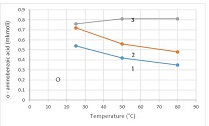
Melanoidin complex formed as a result of interaction between protein amino acids and sugars consists not only of high-molecular compounds, but its important colored part is relatively low-molecular. Based on the example of interaction between glycine labeled preparations and D-glucose, we set a goal of study the regularities of glycine carbon atoms inclusion into melanoidin polymers. Carbon atoms of amino acid carboxyl group are quite actively included into melanoidin pigment composition and presumably, this occurs by means of products formed resulting from Amadori rearrangement. In this regard, interesting results have been obtained resulting from study of polymeric products of Maillard reaction going between D-glucose and 1-alanine. Results of element analysis of polymers obtained by us (>3500 Daltons) show that CN ratio, as one of the main parameters of these polymers, is smaller for products formed at pH8,0, than those formed at pH 5,8. Such regularity, when CN ratio of melanoidin polymers decreases with increase of pH, is described for products of alanine and glucose interactions. At that, resulting from autoradiographic analysis of acidic hydrolysates of the mentioned melanoidin polymers, there was no free radioactive glycine found in these hydrolysates. Thus, glycine is included into polymer composition not in the form of united molecular chain, but as a molecule fragment. Based on these data one may conclude that roughly 65% of methylene carbon and approx. 14% of carboxyl carbon of glycine molecule are incorporated into melanoidin polymers under conditions we have studied. The melanoidin polymer obtained at 100°C temperature and pH 5,8 reacts with glycine at pH 8.0, the melanoidin polymer obtained at 80°C temperature reacts with glycine at 100°C temperature etc. The degree of glycine labeled carbon’s inclusion into melanoidin is more highly influenced by pH change than by temperature rise.
Downloads
References
Martins S.I. F. S. Unravelling the Maillard reaction Network by Multiresponse Kinetic Modelling. Ph. D. Thesis, Wageningen University. The Netherlands. 2003.
Wedzicha B.I., Kaputo M. T. Melanoidins from Glucose and Glycine: Composition, Characteristics and Reactivity towards Sulphite Ion. Food Chemistry, 1992,43, 359-367.
Feather M.S., Huang R.D. Some Studies on a Maillard Polymer Derived from L-Alanine and D-glucose. In Amino-Carbonil React. Food and Biol. Syst. Proc. 3rd Int. Symp. Maillard React., Susono, 1985. Tokio, Amsterdam, 1986, 183-192.
N. G. Karkashadze, R. Z. Uridia, N. P. Tserodze, L. T. Tatiashvili, S. A. Gvidani, N. T. Boikvadze and L. A. Dolidze. N-glycosylation of proteins. World journal of Advanced Research and Reviews, 2025, 26 (01), 3570-3575. DOI: https: // doi.org/10.30574/ wjarr. 2025. 26. 1. 1348
Kublashvili R.L., Ugrekhelidze D. Sh., Incorporation of Glycine Carbon Atoms into Melanoidin Polymers Chemistry of Natural Compounds 2005, v. 41, №3, 336-339.
Hayashi T., Namiki M. Role of Sugar Fragmentation in an Early Stage Browning of Amino carbonyl Reaction of Sugar with Amino Acid. Agric. Biol. Chem., 1986, 50, 1965-1970.

Downloads
Published
How to Cite
Issue
Section
License
Copyright (c) 2025 Georgian Scientists

This work is licensed under a Creative Commons Attribution-NonCommercial-NoDerivatives 4.0 International License.