
THE SCIENTIFIC DISCUSSION OF KEY ISSUE ASPECTS OF IMMUNOPATHOGENESIS AND PHARMACOLOGICAL PROPERTIES AND PROFILES IN RELATION TO ADVERSE DRUG REACTIONS CHALLENGES, FOCUS ON MULTIDIMENSIONAL DRUG-INDUCED EOSINOPHILIA AND SYSTEMIC SYNDROME

ჩამოტვირთვები




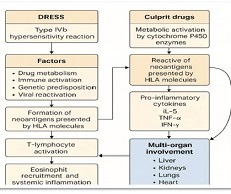
Drug-induced eosinophilia and systemic symptoms (DIES) represent a complex and potentially life-threatening spectrum of adverse drug reactions characterized by eosinophilic infiltration and multiorgan involvement. This review synthesizes current knowledge on the pharmacological, immunological, and clinical aspects of these reactions, with particular emphasis on severe manifestations such as drug reaction with eosinophilia and systemic symptoms (DRESS). We examine the mechanisms by which specific drug classes—including aromatic antiepileptics, antibiotics, and novel biologics—trigger eosinophil activation through hapten formation, direct T-cell stimulation, and cytokine release. Genetic predispositions, particularly HLA associations, and viral interactions (e.g., HHV-6 reactivation) are discussed as critical modulators of individual susceptibility and clinical severity. Recent advances in biomarker discovery (e.g., serum Siglec-8, eosinophil-derived extracellular traps) and imaging modalities (e.g., 68Ga-FAPI PET/CT) are evaluated for their diagnostic and prognostic utility. The review highlights emerging therapeutic strategies, including targeted biologics against IL-5/IL-33 and pharmacogenomic approaches to prevention, while underscoring persistent challenges in management, such as corticosteroid dependence and long-term sequelae. By integrating mechanistic insights with clinical observations, this work aims to refine diagnostic criteria, optimize therapeutic decision-making, and identify future research directions to mitigate the burden of these iatrogenic complications. Drug Reaction with Eosinophilia and Systemic Symptoms (DRESS) is an uncommon yet serious adverse drug reaction that presents with delayed systemic inflammation and multiple organ involvement. It is a member of the spectrum of severe cutaneous adverse reactions (SCAR), usually presenting 2–8 weeks post initiation of the culprit drug. Nonspecific symptoms, latency, and overlapping clinical findings with infections, autoimmune diseases, and other hypersensitivity reactions contribute to a failure to diagnose syndrome and worsening morbidity. The objective of this thesis is to conduct a comprehensive systematic review with emphasis on the pharmacological characteristics, clinical presentation, and genetic risk factors of DRESS syndrome, as well as a range of pathological drug classes, including anticonvulsants, antibiotics, allopurinol, and nonsteroidal anti-inflammatories (NSAIDs). The article also discusses treatment, long-term prognosis and research directions. The leading alternative agents were anticonvulsants (e.g., carbamazepine, phenytoin, lamotrigine), antibiotics (e.g., vancomycin, minocycline), allopurinol, and NSAIDs including mefenamic acid and ibuprofen. More than 60 % of cases had hepatic involvement; involvement of the kidneys (25 %) and the lungs (10–15 %) were also important. Nearly all patients presented with cutaneous findings, most commonly a diffuse morbilliform rash and facial edema, and frequently had fever and eosinophilia. Genetic predisposition is an important factor, with HLA-B58:01 allele in the context of allopurinol-induced DRESS, and HLA-A31:01 in the case of carbamazepine. These results emphasize the value of pharmacogenetic screening in high-risk population groups. Viral reactivation, including human herpesvirus-6 (HHV-6), had been observed in multiple patients and has contributed to overall disease severity and duration. Therapy consisted mainly in early discontinuation of the inducing agent and systemic corticosteroids. Although the majority of patients responded to corticosteroids, some became steroid resistant and were treated with medications such as cyclosporine, IVIG, and plasmapheresis. There is a lack of standardized treatment protocols, and randomized controlled trials are highly desired. Relapses during corticosteroid reduction or autoimmunity (type 1 diabetes, thyroiditis, lupus-like syndromes) occurred in some, but not in all patients. Multisystem DRESS syndrome mandates a high degree of clinical suspicion for early diagnosis and treatment. The underestimation of NSAID-induced DRESS emphasises the necessity for better pharmacovigilance tools and public awareness on OTC drug safety. Future advances would need to focus on the creation of general diagnostic criteria, useful biomarkers for early diagnosis, and the use of evidence-based algorithms for treatment.
Downloads
Kong, D., Dixit, K., Konje, S., Gandhi, K., Salman, S., Moras, E., & Agarwal, V. (2023). Drug reaction with eosinophilia and systemic Symptoms-Associated perimyocarditis after initiation of anti-tuberculosis therapy: a case report. Cureus.
Krantz, M. S., & Phillips, E. J. (2023). Drug reaction with eosinophilia and systemic symptoms. JAMA Dermatology, 159(3), 348.
Lee, S., Nam, Y. H., Koh, Y., Kim, S. H., Kim, S., Kang, H., Kim, M., Lee, J., Park, J., Park, H., La, H. O., Kim, M., Park, S. J., Kwon, Y., Jung, J., Kim, S. H., Kim, C., Yang, M., Kang, M., . . . Ye, Y. (2019). Phenotypes of severe cutaneous adverse reactions caused by nonsteroidal anti-inflammatory drugs. Allergy Asthma and Immunology Research, 11(2), 212.
Li, J. C. (2022). Reactivation of Human Herpesvirus (HHV) 6 as Etiology of Acute Liver Injury in Drug Reaction With Eosinophilia and Systemic Symptoms (DRESS) syndrome: A Case Report. Cureus.
Liang, C., An, P., Zhang, Y., Liu, X., & Zhang, B. (2024). Fatal outcome related to drug reaction with eosinophilia and systemic symptoms: a disproportionality analysis of FAERS database and a systematic review of cases. Frontiers in Immunology, 15.
Loranger, N., Karn, E., Anderson, J., Groover, M., Wang, D., Schmults, C., Ruiz, E., & Waldman, A. (2024). Subcutaneous injection of tranexamic acid reduces postoperative bleeding following Mohs micrographic surgery: A single-institution cohort study. Journal of the American Academy of Dermatology, 91(3), 542–544.
Maideen, N. M. P., Barakat, I. R., & Jumale, A. H. (2023). Paracetamol (Acetaminophen)-associated SJS, TEN, AGEP, and DRESS syndromes - A narrative review. Current Drug Safety, 19(2), 218–223.
Manieri, E., Dondi, A., Neri, I., & Lanari, M. (2023). Drug rash with eosinophilia and systemic symptoms (DRESS) syndrome in childhood: a narrative review. Frontiers in Medicine, 10.
Maris, B. R., Grama, A., & Pop, T. L. (2025). Drug-Induced Liver Injury—Pharmacological spectrum among children. International Journal of Molecular Sciences, 26(5), 2006.
Martin, G., Lambert, E., & Wang, G. K. (2023). Drug reaction with eosinophilia and Systemic symptoms (DRESS) syndrome caused by apalutamide: a case presentation. Cureus. https://doi.org/10.7759/cureus.41687 Martin, G., Lambert, E., & Wang, G. K. (2023). Drug reaction with eosinophilia and Systemic symptoms (DRESS) syndrome caused by apalutamide: a case presentation. Cureus.
Martins, J. C., Seque, C. A., & Porro, A. M. (2022). Clinical aspects and therapeutic approach of drug-induced adverse skin reactions in a quaternary hospital: a retrospective study with 219 cases. Anais Brasileiros De Dermatologia, 97(3), 284–290.
Miyagawa, F., Mizukawa, Y., Hayashino, Y., Nakamura-Nishimura, Y., & Asada, H. (2025). Risk factors associated with cytomegalovirus infection in patients with drug-induced hypersensitivity syndrome/drug rash with eosinophilia and systemic symptoms (DIHS/DRESS): Comparison with a population with drug eruptions. JAAD International.
Moshayedi, M. A., Asilian, A., & Mokhtari, F. (2024). Evaluation of severe adverse cutaneous drug reactions in patients admitted to tertiary care center: A cross‐sectional study. Health Science Reports, 7(3).
Mustafa, S. F., Zafar, M. R., & Miller, T. W. (2020). Rosuvastatin Use Implicated in the Drug Reaction with Eosinophilia and Systemic Symptoms. Cureus.
Nafil, H., Tazi, I., Sifessalam, M., Bouchtia, M., & Mahmal, L. (2012). Dress syndrome induit par l’ibuprofène révélé par un ictère fébrile. Journal Africain D Hépato-Gastroentérologie, 6(2), 85–86.
Nam, Y., Park, Nam, H., Lee, S., Kim, K., Roh, Um, S., & Son, C. (2014). Drug reaction with eosinophilia and systemic symptoms syndrome is not uncommon and shows better clinical outcome than generally recognised. Allergologia Et Immunopathologia, 43(1), 19–24.
Nguyen, K., & Ahmed, M. S. (2018). Drug Rash with Eosinophilia and Systemic Symptoms Syndrome Presenting After the Initiation of Staphylococcus hominis Infectious Endocarditis Treatment: A
Nova, V. V., Cotta, C., Da Ponte, G., & Mendes, S. (2013). 1738 – The lethal potential of lamotrigine - dress syndrome. European Psychiatry, 28, 1. O’Keefe, L. J., & Burtson, K. M. (2023). A case of primary Epstein-Barr virus infection masquerading as drug reaction with eosinophilia and systemic symptoms. Cureus.
Aphkhazava, David, Nodar Sulashvili, and Jaba Tkemaladze. 2025. “Stem Cell Systems and Regeneration”. Georgian Scientists 7 (1):271-319. https://doi.org/10.52340/gs.2025.07.01.26.
Aphkhazava, D., Sulashvili, N., Tupinashvili, T., & Nozadze, M. (2024). Dynamic Cellular Equilibrium Theory of Aging: Integrating Maintenance and Accumulation in the Aging Process. Scientific Journal „Spectri“, 8(2). https://doi.org/10.52340/spectri.2023.08.02.03
Aphkhazava, D., Tuphinashvili, T., Sulashvili, N., & Nozadze, M. (2023). The Features and Role of SHP2 Protein in Postnatal Muscle Development. Scientific Journal „Spectri“, 1. https://doi.org/10.52340/spectri.2023.01
Nodar Sulashvili, Nana Gorgaslidze, Margarita Beglaryan, Luiza Gabunia, Nato Alavidze, Nino Abuladze, Marina Giorgobiani, Marika Sulashvili, Tamar Okropiridze, and Lali Patsia. 2025. “THE SCIENTIFIC DISCOURSE OF KEY ISSUE ASPECTS OF FEATURES OF CANDIDA PROBLEMS, ANTIFUNGAL DRUGS RESISTANCE CONCERNS, MYCOTOXICOLOGY ISSUES, MYCOECOLOGY, BIOSAFETY RISKS AND EMERGING SOLUTIONS”. Modern Scientific Method, no. 9 (March). https://ojs.scipub.de/index.php/MSM/article/view/5423.
Paljärvi, T., McPherson, T., Thompson, C., Luciano, S., Herttua, K., & Fazel, S. (2024). Neuropsychiatric diagnoses after isotretinoin initiation in pediatric acne patients: A retrospective cohort study. Journal of the American Academy of Dermatology, 91(3), 571–573.
Parsi, M., & Daniel, C. (2020). Lamotrigine-induced DRESS syndrome manifesting as ‘Eosinophilic colitis’: an uncommon presentation of a very uncommon condition. Cureus.
Paul, P., Kamal, R., & Bhatia, R. (2024). The Hidden Dangers of Meftal: A drug safety alert for a frequently used NSAID. Current Pharmaceutical Design, 30(25), 1949–1951.
Qadir, N. A., Marsalisi, C., Reddy, A. D., Stachler, L., & Onteddu, N. (2024). A dermatological dilemma: the importance of recognizing dermatologic manifestations of drug reaction with eosinophilia and systemic symptoms (DRESS) in skin of color patients. Cureus.
Robinson, F., Webber, L., Ormerod, E., & Keith, D. (2025). An extremely prolonged case of drug reaction with eosinophilia and systemic symptoms (DRESS Syndrome) secondary to a penicillin-based antibiotic. Anais Brasileiros De Dermatologia.
Sahukar, S., & Byranahalli, V. C. (2024). Drug reaction with eosinophilia and systemic symptoms (DRESS) syndrome: a case report from South India. Cureus.
Saleem, A., Waheed, H., & Fatima, S. (2025). The rash that unraveled: a case report of DRESS syndrome in a 45-Year-Old woman. Medical Reports, 100192.
Saper, V. E., Tian, L., Verstegen, R. H. J., Conrad, C. K., Cidon, M., Hopper, R. K., Kuo, C. S., Osoegawa, K., Baszis, K., Bingham, C. A., Ferguson, I., Hahn, T., Horne, A., Isupova, E. A., Jones, J. T., Kasapcopur, Ö., Klein-Gitelman, M. S., Kostik, M. M., Ozen, S., . . . Mellins, E. D. (2024). Interleukin (IL)-1/IL-6-Inhibitor–Associated Drug Reaction with eosinophilia and Systemic Symptoms (DRESS) in systemic inflammatory illnesses. The Journal of Allergy and Clinical Immunology in Practice, 12(11), 2996-3013.e7.
Sasi, S., Altarawneh, H., Petkar, M. A., & Nair, A. P. (2020). Drug Reaction with Eosinophilia and Systemic Symptoms Secondary to Naproxen: A Case Report and Systematic review. Case Reports in Acute Medicine, 3(2), 63–72.
Saxena, S., & Singh, S. (2021). Efficacy and tolerability of eslicarbazepine acetate as monotherapy in patients of newly diagnosed focal epilepsy. European Psychiatry, 64(S1), S774–S775.
Shakour, H., Mumtaz, R., & Abu-Samra, A. (2025). A diagnostic dilemma: Daptomycin-Induced drug reaction with eosinophilia and Systemic Symptoms (DRESS) syndrome and eosinophilic pneumonia with concurrent COVID-19. Cureus.
Shiohara, T., & Mizukawa, Y. (2019). Drug-induced hypersensitivity syndrome (DiHS)/drug reaction with eosinophilia and systemic symptoms (DRESS): An update in 2019. Allergology International, 68(3), 301–308.
Sqalli-Houssini, G., Douhi, Z., Soughi, M., Elloudi, S., Baybay, H., Moukafih, B., Omari, M., Rhazi, K. E., & Mernissi, F. (2024). Drug reaction with eosinophilia and systemic symptoms: Analysis of cutaneous phenotype as a prognosis factor. Revue Française D’allergologie, 64(6), 104161.
St George-Hyslop, F., Cherepacha, N., Chugani, B., Alabdeen, Y., Sanchez-Espino, L. F., Mahood, Q., Sibbald, C., & Verstegen, R. H. J. (2024). Clinical Presentation and Diagnosis of Drug Reaction with Eosinophilia and Systemic Symptoms (DReSS) in Children: A Scoping Review. Clinical Reviews in Allergy & Immunology, 66(1), 112–123.
Taweesedt, P. T., Nordstrom, C. W., Stoeckel, J., & Dumic, I. (2019). Pulmonary Manifestations of Drug Reaction with Eosinophilia and Systemic Symptoms (DRESS) Syndrome: A Systematic Review. BioMed Research International, 2019, 1–10.
Thaw, K. M., Ko, E. K., & Kazi, A. U. (2024). Atypical presentation of drug reaction with eosinophilia and systemic symptoms (DRESS) syndrome: when gastrointestinal symptoms obscure the diagnosis. Cureus.
Thompson, G., Ali, S., Trevenen, M., Vlaskovsky, P., Murray, K., & Lucas, M. (2024). Distinguishing DRESS syndrome from drug rash and eosinophilia: beyond the RegiSCAR criteria. Journal of Allergy and Clinical Immunology Global, 3(4), 100346.
Tran, H., & Bhatt, G. (2024). Atypical presentation of drug reaction with eosinophilia and systemic symptoms (DRESS) in a patient on pembrolizumab: a case report. Cureus.
Tsevat, R. K., Fisher, O., Tsevat, D. G., Brigmon, E., Crane, C., Hartzler, A., Becker, E. M., Brooks, E. G., Kaur, S., & Tsevat, J. (2023). Drug reaction with eosinophilia and systemic symptoms (DRESS) with eosinophilic cholecystitis triggered by topical diclofenac. Annals of Internal Medicine Clinical Cases, 2(12).
Waseem, H., Inayat, F., Abduraimova, M., & Kamholz, S. (2017). Allopurinol-Induced Drug Reaction with eosinophilia and Systemic Symptoms syndrome: a cause of acalculous cholecystitis? Cureus.
Watanabe, H. (2018). Recent Advances in Drug-Induced Hypersensitivity Syndrome/Drug Reaction with Eosinophilia and Systemic Symptoms. Journal of Immunology Research, 2018, 1–10.
Weaver, M. D., Glass, B., Aplanalp, C., Patel, G., Mazhil, J., Wang, I., & Dalia, S. (2024). Review of Peripheral blood eosinophilia: Workup and Differential diagnosis. Hemato, 5(1), 81–108.
Wei, B. M., Fox, L. P., Kaffenberger, B. H., Korman, A. M., Micheletti, R. G., Mostaghimi, A., Noe, M. H., Rosenbach, M., Shinkai, K., Kwah, J. H., Phillips, E. J., Bolognia, J. L., Damsky, W., & Nelson, C. A. (2023). Drug-induced hypersensitivity syndrome/drug reaction with eosinophilia and systemic symptoms. Part I. Epidemiology, pathogenesis, clinicopathological features, and prognosis. Journal of the American Academy of Dermatology, 90(5), 885–908.
Woessner, K. M., & Castells, M. (2013). NSAID Single-Drug–Induced Reactions. Immunology and Allergy Clinics of North America, 33(2), 237–249.
Wolfson, A. R., Zhou, L., Li, Y., Phadke, N. A., Chow, O. A., & Blumenthal, K. G. (2018). Drug Reaction with Eosinophilia and Systemic Symptoms (DRESS) Syndrome Identified in the Electronic Health Record Allergy Module. The Journal of Allergy and Clinical Immunology in Practice, 7(2), 633–640.
Bocquet, Hugues, Martine Bagot, and Jean-Claude Roujeau. "Drug-Induced Pseudolymphoma and Drug Hypersensitivity Syndrome (Drug Rash with Eosinophilia and Systemic Symptoms: DRESS)." Seminars in Cutaneous Medicine and Surgery 15, no. 4 (1996): 250-257.
Cacoub, Patrice, Philippe Musette, and Valérie Descamps. "The DRESS Syndrome: A Literature Review." American Journal of Medicine 124, no. 7 (2011): 588-597.
Chen, Yin-Chun, Chuang-Wei Wang, and Chun-Bing Chen. "Drug Reaction with Eosinophilia and Systemic Symptoms (DRESS): An Update on Pathophysiology and Management." Journal of Allergy and Clinical Immunology in Practice 9, no. 4 (2021): 1493-1501.
Cho, Young-Tae, Chia-Yu Chu, and Wen-Hung Chung. "The Pathophysiology of DRESS Syndrome: The Role of Herpesvirus Reactivation." Journal of Immunology Research 2015 (2015): 1-8.
Descamps, Valérie, and Philippe Musette. "Drug Reaction with Eosinophilia and Systemic Symptoms (DRESS)." Clinics in Dermatology 38, no. 6 (2020): 702-711.
Husain, Zafar, Bryan E. Byrnes, and Luz Fonacier. "Severe Cutaneous Adverse Drug Reactions: Presentation, Risk Factors, and Management." Current Allergy and Asthma Reports 18, no. 4 (2018): 26.
Kardaun, Sylvia H., and Maja Mockenhaupt. "Drug Reaction with Eosinophilia and Systemic Symptoms (DRESS): Multiorgan Disease with Variable Clinical Features." Journal of the European Academy of Dermatology and Venereology 33, no. 6 (2019): 1001-1013.
Pichler, Werner J., Andreas Naisbitt, and Daniel Yerly. "The Changing Face of Drug Hypersensitivity." Journal of Allergy and Clinical Immunology 143, no. 1 (2019): 50-57.
Roujeau, Jean-Claude. "Clinical Heterogeneity of Drug Hypersensitivity." Toxicology 209, no. 2 (2005): 123-129.
Shiohara, Tetsuo, and Yoko Kano. "Drug Reaction with Eosinophilia and Systemic Symptoms (DRESS): Incidence, Pathogenesis and Management." Expert Opinion on Drug Safety 16, no. 2 (2017): 139-147.
Sidoroff, Alexis, and Jean-Claude Roujeau. "Cutaneous Adverse Reactions to Drugs." Clinical Dermatology 26, no. 1 (2008): 11-18.
Tohyama, Mikiko, and Kazuhiko Hashimoto. "New Aspects of Drug-Induced Hypersensitivity Syndrome." Journal of Dermatology 38, no. 3 (2011): 222-228.
Walsh, Sarah A., and Neil H. Shear. "Drug Reaction with Eosinophilia and Systemic Symptoms: Is Cutaneous Phenotype a Prognostic Marker for Outcomes? A Review of Clinicopathological Features of 27 Cases." Journal of Cutaneous Medicine and Surgery 17, no. 4 (2013): 245-251.
Wolfson, Anna R., and Elizabeth J. Phillips. "Advances in the Understanding of Drug Hypersensitivity: 2012 Through 2022." Journal of Allergy and Clinical Immunology 151, no. 3 (2023): 689-702.
Yang, Chih-Wan, and Wen-Hung Chung. "Genetic Predisposition to Drug Hypersensitivity." Pharmacogenomics 21, no. 2 (2020): 89-101.
Zvulunov, A. (2013). Primum non nocere, or treat the patient, not the disease. Journal of the American Academy of Dermatology, 69(6), 1055–1056.
საავტორო უფლებები (c) 2025 ქართველი მეცნიერები

ეს ნამუშევარი ლიცენზირებულია Creative Commons Attribution-NonCommercial-NoDerivatives 4.0 საერთაშორისო ლიცენზიით .