
Alkaloids and Anatomical Structure of Vegetative Organs of Consolida orientalis (J.Gay) Schrödinger from the Flora of Georgia

Загрузки




This study investigates the alkaloid composition of Consolida orientalis (J. Gay) Schrödinger from the flora of Georgia, alongside a comprehensive evaluation of the macroscopic and microscopic characteristics of its vegetative organs. The objective is to establish reliable diagnostic features for taxonomic identification.
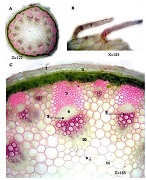
The aerial vegetative organs of are covered with simple, conical, curved, unicellular, non-glandular trichomes. The stem internode exhibits a monocyclic stelar arrangement; the vascular cylinder is characterized by discrete, open collateral bundles. The leaf segments are bifid, amphistomatic, and dorsiventral in organization. Both adaxial and abaxial epidermal layers are distinctly cuticularized, displaying sinuous, zigzag-angular anticlinal cell walls. The stomatal apparatus is of the anomocytic type.
The root of C. orientalis has a polyarch structure. Xylem vessels are differentiated in grouped and longitudinally aligned rows, with predominantly pitted wall thickening and simple perforation plates. The transitional system of the root consists of homogeneous radial rays with a tendency to widen toward the cortical region.
Phytochemical investigation, supported by GC–MS analysis, demonstrated that the purified total alkaloid fraction obtained from the vegetative organs of C. orientalis via liquid–liquid extraction is predominantly composed of diterpenoid alkaloids, including delcosine, gigactonine, and lycoctonine.
Скачивания
საქართველოს ფლორა ტ.II, გამ.”მეცნიერება” თბილისი 1973, გვ.65-69;
საქართველოს ფლორის ნომენკლატურული ნუსხა; თბილისი 2018, გვ.155;
R. Gagnidze Vascular plants of Georgia a nomenclatural checklist. Tbilisi. 2005. 33-34;
G. Rocchetti; G.Zengin; Y. Cakmak; M.Mahmodally; M.Kaya; S. Alsheikh; J. Glamocilja; M. Sokovic; D. Lobine; L. Lucini. A UHPLC-QTOF-MS screening provides new insights into the phytochemical composition and biological properties of six Consolida species from Turkey. Industrial Crops and Products, 2020, 158, 112966;
https://www.gbif.org/ru/species/search?q=consolida
L. Fang; C. Yang; L. Jing-yu; L. Jing-han -Advances in the studies on the pharmacological activities and toxicities of C19 diterpenoid alkaloids. Strait Pharm. J. 2012, v.24, n.4,Pp. 1–12.
T. Xu; S. Liu; L. Meng; Z. Pi; F. Song; Z. Liu - Bioactive Heterocyclic Alkaloids with Diterpene Structure isolated from Traditional Chinese Medicines; Journal of Chromatography B, 2015, 1026, 56-66;
T. Yin; L.Cai; Z. Ding - A systematic review on the chemical constituents of the genus Consolida (Ranunculaceae) and their biological activities. RSC Adv. 2020 Sep 22;10(58):35072–35089. doi: 10.1039/d0ra06811j
Copyright (c) 2026 Georgian Scientists

Это произведение доступно по лицензии Creative Commons «Attribution-NonCommercial-NoDerivatives» («Атрибуция — Некоммерческое использование — Без производных произведений») 4.0 Всемирная.