The Limits of Deliberation: TV Debate on Higher Education System Changes in Georgia

Downloads




The presented article deals with the study of the deliberative quality of a television debate on the example of a public discussion held on the air of Imedi TV, a TV media affiliated with the Georgian government. The discussion concerned the fundamental changes taking place in the education system. The aim of the study is to analyze, on the one hand, the creation of the discussion agenda - setting by the participants of the debate as a genre of analytical journalism, and, on the other hand, the perception of these discursive frames by the online audience. The focus was on the methods, namely, the use of evidence and authority, that the program guests resorted to in order to gain access to the discourse.
The article is based on media monitoring and an in-depth analysis of the case of television coverage of different opinions about the changes taking place in the higher education system.
It is noteworthy that, based on monitoring, out of 127 episodes of four television analytical programs that were broadcast from the date of the presentation of the “National Concept of Higher Education” (October 16, 2025) to the start of the 2026 national exams (July 2, 2026), only 4 episodes were devoted to the ongoing changes in the education system, and public discussion between actors of different statuses with different opinions took place on television only once, in the February 14, 2026 episode of the analytical program “Open Air - Debates” of Imedi TV Company. Accordingly, the transcript of the aforementioned program was analyzed using an adapted version of the Discourse Quality Index, thematic agenda of the discussion, argumentation, and discursive legitimacy approaches. In order to identify the peculiarities of the perception of discourse frames by the addressees, a qualitative content analysis of 122 Georgian-language comments published on YouTube was conducted.
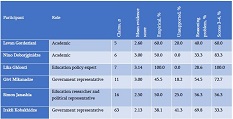
The study found that the program’s guests did not have equal access to the discourse. Accordingly, asymmetry was also evident in terms of creating the thematic agenda of the discussion. In particular, 13 out of 19 main topics were raised by the Prime Minister, Irakli Kobakhidze. He also occupied more airtime than other guests, and it is noteworthy that 63 out of 108 coded assertions belong to him. However, as for reasoning with evidence, his discourse was less based on empirical substantiation than that of other participants in the program. Although academics and education policymakers did not gain communicative dominance because they provided less evidence, their arguments were more likely to be supported by consistent empirical data and professional knowledge.
Notably, 30.6% of the overall criticisms presented in the program were unsubstantiated, while 60.2% contained at least 1 reasoning flaw. The deliberative quality of the debate we studied was also limited by the 31 episodes that featured irony, sarcasm, and personal and/or professional discredit.
Qualitative content analysis of 122 comments from the online audience confirmed that commentators were not passive recipients of the message. The analysis revealed the repetition, reinforcement, transformation with polarized interpretations and, in some cases, replacement with specific political frameworks of discursive frames.
Thus, an in-depth analysis of one case, the February 14, 2026 episode of the Imedi TV program “Open Air – Debates”, showed that formal pluralism could not be transformed into a substantively equal deliberative discourse on television. However, it should be emphasized that the results obtained cannot be generalized, since they were revealed only in one purposefully selected episode. On the other hand, it is worth noting that the results of the study presented in the article create a fundamental basis for further large-scale research in order to determine whether the asymmetry we have identified is only a feature of this specific program or a characteristic of the Georgian polarized media system.
Downloads
Becker, G. S. (1964). Human capital: A theoretical and empirical analysis, with special reference to education. Columbia University Press. https://www.nber.org/books-and-chapters/human-capital-theoretical-and-empirical-analysis-special-reference-education-first-edition
Bennett, W. L. (1990). Toward a theory of press-state relations in the United States. Journal of Communication, 40(2), 103–127. https://doi.org/10.1111/j.1460-2466.1990.tb02265.x
Chkhetiani, L. (2025). How polarised are Georgians? CRRC-Georgia. https://crrc.ge/en/blog-how-polarized-are-georgians/
Dee, T. S. (2004). Are there civic returns to education? Journal of Public Economics, 88(9–10), 1697–1720. https://doi.org/10.1016/j.jpubeco.2003.11.002
Dewey, J. (199 [1926]7). Democracy and education: An introduction to the philosophy of education. Project Gutenberg. https://www.gutenberg.org/ebooks/852
Durkheim, É. (1956 [1922]). Education and sociology (S. D. Fox, Trans.). Free Press. https://books.google.ge/books?id=HcG3zQEACAAJ
Fairclough, N. (1992). Discourse and social change. Polity Press.
Fraser, N. (1992). Rethinking the public sphere: A contribution to the critique of actually existing democracy. In C. Calhoun (Ed.), Habermas and the public sphere (pp. 109–142). MIT Press.
Georgian Charter of Journalistic Ethics. (2024a, December 20). Satelevizio akhali ambebis monitoringis angarishi [Television news monitoring report]. https://www.qartia.ge/ka/mediamonitoringi/article/99377
Georgian Charter of Journalistic Ethics. (2024b, December 20). Satelevizio tokshouebis monitoringis angarishi [Television talk-show monitoring report]. https://www.qartia.ge/ka/mediamonitoringi/article/99378
Gerring, J. (2007). Case study research: Principles and practices. Cambridge University Press.
Gersamia, M., Toradze, M., & Bandzeladze, M. (2023). Media environment 2023: Challenges during political polarization and crisis in Georgia. Media and Communication Educational and Research Center “Media Voice.” https://doi.org/10.52340/9789941862014
Gersamia, M., Toradze, M., & Bandzeladze, M. (2024). Trust in media and effects of political polarization in Georgia [Conference abstract]. Environment and Society, 12(12). https://www.es.tsu.ge/index.php/es/article/view/192
Gerstl-Pepin, C. I. (2002). Media (mis)representations of education in the 2000 presidential election. Educational Policy, 16(1), 37–55. https://doi.org/10.1177/0895904802016001003
Gerstl-Pepin, C. I. (2007). Introduction to the special issue on the media, democracy, and the politics of education. Peabody Journal of Education, 82(1), 1–9. https://doi.org/10.1080/01619560709336534
Giddens, A. (2009). Sociology (6th ed.; rev. and updated with P. W. Sutton). Polity.
Government of Georgia. (2025a, January 20). Umaghlesi ganatlebis reformis samtavrobo komisiis shekmnis shesakheb [On the establishment of the Government Commission for Higher Education Reform] (Ordinance No. 103). https://www.gov.ge/files/618_91009_188575_103.pdf
Government of Georgia. (2025b, December 1). Umaghlesi ganatlebis sistemis reformis erovnuli kontseptsiis damtkicebis shesakheb [On approval of the national concept for reform of the higher education system] (Ordinance No. 1994). https://www.gov.ge/files/618_94373_219748_1994.pdf
Habermas, J. (1989 [1962]). The structural transformation of the public sphere: An inquiry into a category of bourgeois society (T. Burger, Trans.). MIT Press.
Habermas, J. (1996 [1992]). Between facts and norms: Contributions to a discourse theory of law and democracy (W. Rehg, Trans.). MIT Press.
Hall, S. (1980). Encoding/decoding. In S. Hall, D. Hobson, A. Lowe, & P. Willis (Eds.), Culture, media, language: Working papers in cultural studies, 1972–79 (pp. 128–138). Hutchinson.
Kincha, S. (2021, July 23). Georgian Dream’s anti-media crusade continues. OC Media. https://oc-media.org/georgian-dreams-anti-media-crusade-continues/
Magin, M., Stark, B., Jandura, O., Udris, L., Riedl, A., Klein, M., Eisenegger, M., Kösters, R., & Hofstetter Furrer, B. (2023). Seeing the whole picture: Towards a multi-perspective approach to news content diversity based on liberal and deliberative models of democracy. Journalism Studies, 24(5), 669–696. https://doi.org/10.1080/1461670X.2023.2178248
McCombs, M. E., & Shaw, D. L. (1972). The agenda-setting function of mass media. Public Opinion Quarterly, 36(2), 176–187. https://doi.org/10.1086/267990
Ministry of Education, Science and Youth of Georgia. (2025, October 16). Umaghlesi ganatlebis reformis kontseptsiis prezentatsia [Presentation of the higher education reform concept]. https://mes.gov.ge/content.php?id=14304&lang=geo
Santos, Í., Carvalho, L. M., & Portugal e Melo, B. (2022). The media’s role in shaping public opinion on education: A thematic and frame analysis of externalisation to world situations in the Portuguese media. Research in Comparative and International Education, 17(1), 29–50. https://doi.org/10.1177/17454999211057753
Schultz, T. W. (1961). Investment in human capital. American Economic Review, 51(1), 1–17. https://www.jstor.org/stable/1818907
Shoemaker, P. J., & Vos, T. P. (2009). Gatekeeping theory. Routledge.
Steenbergen, M. R., Bächtiger, A., Spörndli, M., & Steiner, J. (2003). Measuring political deliberation: A discourse quality index. Comparative European Politics, 1(1), 21–48. https://doi.org/10.1057/palgrave.cep.6110002
Thompson, J. B. (1995). The media and modernity: A social theory of the media. Polity Press.
Toulmin, S. E. (2012). The uses of argument. Cambridge University Press.
Tsuladze, L., & Abzianidze, N. (2025). Polarisation through deviation discourse: Strategic usage of Europeanisation by political and media actors in Georgia. East European Politics. Advance online publication. https://doi.org/10.1080/21599165.2025.2491139
van Leeuwen, T. (2007). Legitimation in discourse and communication. Discourse & Communication, 1(1), 91–112. https://doi.org/10.1177/1750481307071986
Copyright (c) 2026 Georgian Scientists

This work is licensed under a Creative Commons Attribution-NonCommercial-NoDerivatives 4.0 International License.