
Immunophenotypic Changes during Gastric Carcinogenesis: Expression Patterns of CDX2, SOX2, Ki67, and p53 in Gastric Precancerous Lesions and Adenocarcinoma

Downloads




Gastric carcinogenesis is a multistep process characterized by progressive morphological and molecular changes that progress from chronic gastric injury to invasive adenocarcinoma. Identification of biomarkers associated with lesion progression may improve risk stratification and early diagnosis.
The aim of the study was to examine the immunohistochemical expression patterns of CDX2, SOX2, Ki67, and p53 across the spectrum of gastric carcinogenesis and to assess their association with disease progression.
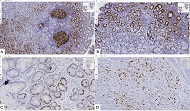
A retrospective cohort study was conducted on 68 formalin-fixed, paraffin-embedded gastric tissue specimens, including normal gastric mucosa, chronic atrophic gastritis, enteric metaplasia complete, enteric metaplasia incomplete, low-grade dysplasia, high-grade dysplasia, intestinal-type gastric adenocarcinoma, and diffuse-type gastric adenocarcinoma. Immunohistochemical staining for CDX2, SOX2, Ki67, and p53 was performed. Expression patterns were evaluated and correlated with lesion severity. The results of the study showed that CDX2 expression significantly increased during the transition from normal gastric mucosa to intestinal metaplasia and dysplasia, reflecting progressive intestinal differentiation. SOX2 expression, on the other hand, showed a gradual decrease, indicating a loss of the gastric epithelial phenotype. Ki67 proliferative activity progressively increased from non-neoplastic lesions to invasive carcinomas. Aberrant expression patterns of p53 expression were predominantly observed in dysplastic lesions and adenocarcinomas. Incomplete intestinal metaplasia showed immunophenotypic features intermediate between complete intestinal metaplasia and dysplasia, confirming its malignant potential. Gastric carcinogenesis is accompanied by progressive changes in epithelial differentiation, proliferative activity, and p53 status. Combined assessment of CDX2, SOX2, Ki67, and p53 may provide valuable information for evaluating gastric precursor lesions and identifying lesions at increased risk of progression to gastric adenocarcinoma.
Downloads
Bekaii-Saab T, El-Rayes B. Identifying and targeting cancer stem cells in the treatment of gastric cancer. Cancer 2017;123:1303–12. https://doi.org/10.1002/cncr.30538.
Yasufuku I, Tsuchiya H, Fujibayashi S, Okumura N, Sengoku Y, Fukada M, et al. Oligometastasis of Gastric Cancer: A Review. Cancers (Basel) 2024;16. https://doi.org/10.3390/CANCERS16030673.
Hu HH, Wang SQ, Zhao H, Chen ZS, Shi X, Chen XB. HER2+ advanced gastric cancer: Current state and opportunities (Review). Int J Oncol 2024;64. https://doi.org/10.3892/IJO.2024.5624.
Acs M, Piso P, Glockzin G. Peritoneal Metastatic Gastric Cancer: Local Treatment Options and Recommendations. Current Oncology 2024;31:1445–59. https://doi.org/10.3390/CURRONCOL31030109.
Prognosis and Treatment of Gastric Cancer: A 2024 Update - PMC n.d. https://pmc.ncbi.nlm.nih.gov/articles/PMC11083929/ (accessed June 10, 2026).
Malfertheiner P, Schulz C, Hunt RH. Helicobacter pylori Infection: A 40-Year Journey through Shifting the Paradigm to Transforming the Management 2024;42:299–308. https://doi.org/10.1159/000538079.
Afkhamipour M, Kaviani F, Dalali S, Piri-Gharaghie T, Doosti A. Potential Gastric Cancer Immunotherapy: Stimulating the Immune System with Helicobacter pylori pIRES2-DsRed-Express-ureF DNA Vaccines. Arch Immunol Ther Exp (Warsz) 2024;72. https://doi.org/10.2478/AITE-2024-0004.
Goldenring JR, Nam KT, Wang TC, Mills JC, Wright NA. Spasmolytic polypeptide-expressing metaplasia and intestinal metaplasia: time for reevaluation of metaplasias and the origins of gastric cancer. Gastroenterology 2010;138:2207–10, 2210.e1. https://doi.org/10.1053/j.gastro.2010.04.023.
Giroux V, Rustgi AK. Metaplasia: tissue injury adaptation and a precursor to the dysplasia-cancer sequence. Nat Rev Cancer 2017;17:594–604. https://doi.org/10.1038/nrc.2017.68.
Barros R, Pereira D, Callé C, Camilo V, Cunha AI, David L, et al. Dynamics of SOX2 and CDX2 Expression in Barrett’s Mucosa. Dis Markers 2016;2016:1532791. https://doi.org/10.1155/2016/1532791.
Barros R, Pereira D, Callé C, Camilo V, Cunha AI, David L, et al. Dynamics of SOX2 and CDX2 Expression in Barrett’s Mucosa. Dis Markers 2016;2016:1532791. https://doi.org/10.1155/2016/1532791.
Karamchandani DM, Lehman HL, Ohanessian SE, Massé J, Welsh PA, Odze RD, et al. Increasing diagnostic accuracy to grade dysplasia in Barrett’s esophagus using an immunohistochemical panel for CDX2, p120ctn, c-Myc and Jagged1. Diagn Pathol 2016;11. https://doi.org/10.1186/S13000-016-0473-7.
Fang Y, Li W, Chen X. P63 Deficiency and CDX2 Overexpression Lead to Barrett’s-Like Metaplasia in Mouse Esophageal Epithelium. Dig Dis Sci 2021;66:4263–73. https://doi.org/10.1007/s10620-020-06756-8.
Meshveliani P, Didava G, Tomadze G, Kepuladze S, Burkadze G. Immunohistochemical Analysis of SOX2, Ki67, and p53 Expression in the Progression of Barrett’s Esophagus to Esophageal Adenocarcinoma. Ქართველი Მეცნიერები 2025;7:437–50. https://doi.org/10.52340/gs.2025.07.01.40.
Wen Y, Hou Y, Huang Z, Cai J, Wang Z. SOX2 is required to maintain cancer stem cells in ovarian cancer. Cancer Sci 2017;108:719–31. https://doi.org/10.1111/cas.13186.
Weina K, Utikal J. SOX2 and cancer: current research and its implications in the clinic. Clin Transl Med 2014;3. https://doi.org/10.1186/2001-1326-3-19.
Tavdgiridze N, Tevdorashvili G, Kepuladze S, Burkadze G. Ki67, CD44, and FOXP3 as Prognostic Markers in Ovarian Immature Teratomas: Implications for Tumor Aggressiveness and Metastasis. Ქართველი Მეცნიერები 2025;7:344–58. https://doi.org/10.52340/gs.2025.07.01.30.
Böger C, Behrens H-M, Röcken C. Ki67--An unsuitable marker of gastric cancer prognosis unmasks intratumoral heterogeneity. J Surg Oncol 2016;113:46–54. https://doi.org/10.1002/jso.24104.
M Fischer MQLSKE. The p53-p21-DREAM-CDE/CHR pathway regulates G2/M cell cycle genes. Nucleic Acids Res 2016;44:164–74.
Blagih J, Buck MD, Vousden KH. p53, cancer and the immune response. J Cell Sci 2020;133. https://doi.org/10.1242/JCS.237453.
Jankowski JA, Wright NA, Meltzer SJ, Triadafilopoulos G, Geboes K, Casson AG, et al. Molecular evolution of the metaplasia-dysplasia-adenocarcinoma sequence in the esophagus. American Journal of Pathology 1999;154:965–73. https://doi.org/10.1016/S0002-9440(10)65346-1.
Copyright (c) 2026 Georgian Scientists

This work is licensed under a Creative Commons Attribution-NonCommercial-NoDerivatives 4.0 International License.