THE THEORY AND PRACTICE OF THE HEALTHCARE ‘GOLDEN TRIANGLE’

Downloads




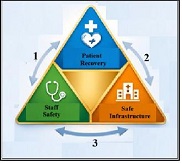
The ultimate goal of the healthcare system is patient recovery and the improvement of quality of life. However, this goal cannot be achieved without guaranteed safety of medical personnel. The health, working capacity, and psychological resilience of staff constitute the foundation upon which patient safety and health rest. Sustainable infrastructure, physical, biological, and chemical factors, construction standards, and procedural order create a supportive environment for risk reduction. The present research focuses on reducing risks directed at medical personnel, but inevitably addresses the so‑called ‘Golden Triangle,’ within which patient recovery, staff safety, and infrastructure sustainability form an integrated system. Each component is essential for the effective realization of healthcare objectives. International practice demonstrates that the implementation of the ‘Golden Triangle’ principles varies according to local specificities: in economically advanced countries, priority is given to infrastructure sustainability (Japan), biological risk control (USA), psychosocial risk management (Germany, Sweden), and reduction of chemical and physical risks (Germany).
Downloads
1. WHO (2022). Occupational health: health workers.
2. WHO (2023). Strategic health infrastructure investments to support universal health coverage.
3. ILO (2024). Global Strategy on Occupational Safety and Health 2024–30.
4. Converso, G., Abate, R., Papa, F. (2025). Risk Management Models Focused on Healthcare Systems. Springer.
5. Montella, L., Ayokunle, O.V., Salvi, F. (2025). Healthcare System Approach for Implementing Risk Management Models. Springer.
6. Molosiwa, T. (2025). Risk Management Systems in Healthcare: Insights and Challenges for Adoption. Journal of Service Science and Management.
7. Lanchava, O., Ilias, N., Radu, S.M., Nozadze, G., Jangidze M. (2022). Preventing the Spread of Combustible Products in Tunnels by Implementing a Divisible System. Environmental Engineering & Management Journal (EEMJ) 21(4), 627-635.
8. Lanchava, O., Ilias, N. (2020). Calculation of railway tunnels ventilation. Journal of Engineering Sciences and Innovation 5 (1), 69-86.
9. Lanchava, O., Ilias, N., Radu, S.M., Nozadze, G., Tsanava, D. (2022). Analysis of the use of transformable elements in intelligent tunnel ventilation systems. MATEC Web of Conferences 354, 00020.
10. Lanchava, O., Ilias, N., Radu, S.M., Jangidze, M., Khokerasvili, Z. (2021). Fire development study on physical models of transport tunnels. MATEC Web of Conferences 342, 03020.
11. Lanchava, O., Bulia, N., Darakhvelidze M. (2025). Ensuring Occupational Safety in the Medical Sector: Key Problems, Systemic Challenges, and Strategic Recommendations. Georgian Scientists 7 (2). https://doi.org/10.52340/gs.2025.07.02.56.
12. Lanchava, O., Gugeshashvili, S. (2024). Occupational Health and Safety Risk Management in the Field of Laboratory Medicine. MATEC Web Conferences, 389, 00077. https://doi.org/10.1051/matecconf/202438900077
13. Ratiani, N., Razmadze, N., Darakhvelidze, M. (2024). Implementation and development of the labor safety system in Georgia and other countries. Georgian Scientists 6 (4), 150-166. https://doi.org/10.52340/gs.2024.06.04.15.
14. Bulia, N. (2026). International Approaches to Psychosocial Risk Assessment in Healthcare. Georgian Scientists 8 (2), 812-819. https://doi.org/10.52340/gs.2026.08.02.63.
15. Gugeshashvili, S., Ratiani, N., Kereselidze M. (2024). Occupational Safety and Health Monitoring for Medical Facility Employees: Risk Assessment and Preventive Measures Mechanisms. Proceedings of the 8th International Scientific Conference “Foundations and Trends in Research”, 8. Copenhagen, Denmark.
Copyright (c) 2026 Georgian Scientists

This work is licensed under a Creative Commons Attribution-NonCommercial-NoDerivatives 4.0 International License.