Techniques of Hyperbolizing Meaning in Arabic
DOI:
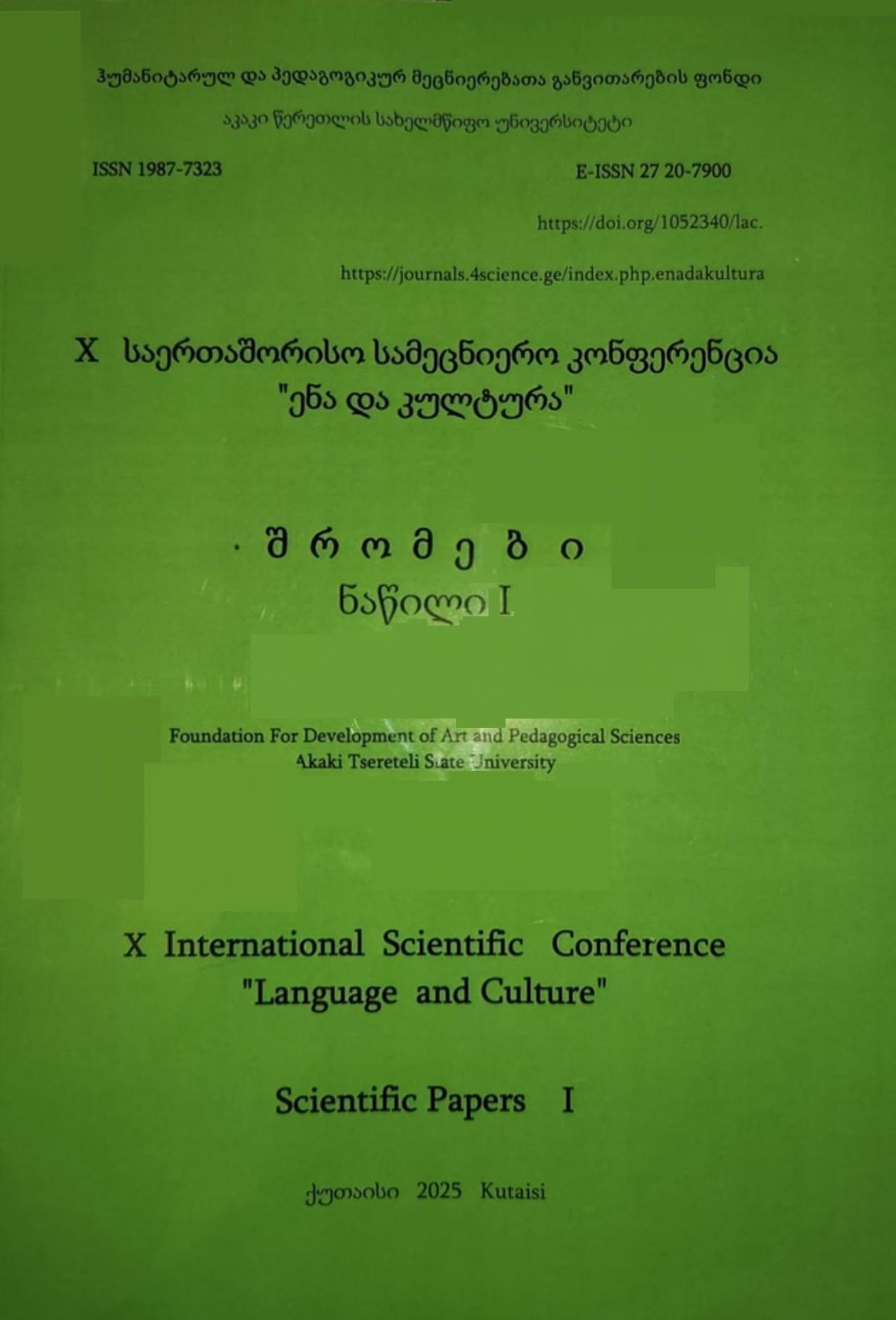
https://doi.org/10.52340/lac.2025.10.23Keywords:
Arabic literature, Techniques of Hyperbolizing MeaningAbstract
One of the characteristic features of Arabic artistic thinking is hyperbolization, amplification, intensification of thought. Arabic offers us a number of means for achieving this effect; they function on the border of grammar and stylistics and relate almost equally to both. The purpose of the paper is to classify and unite those grammatical and stylistic means that usually function in the language completely independently of each other, but when it comes to hyperbolization of the meaning, they are used to achieve this effect with different nuances.
- Grammatical means of hyperbolization of meaning
- a) Paronomasia, as is known, is a construction in which the verb is followed by an adverb of the same (or close) meaning in the accusative case. The main function of a paronymic construction is to emphasize an action with several different semantic shades: a) identification of the type of action, b) expression of the quantity or frequency of the action, and, most often, c) strengthening of the meaning expressed by the verb. If we consider it from a principled position, all these options can be combined into a frame of hyperbolization, amplification, intensification of meaning, since they all imply emphasis, emphasizing.
- b) Form II, built on the model of فَعَّلَ – يُفَعِّلُ, was adapted to convey the strengthening, intensification of meaning in its original, pre-Classical version. It is interesting that the form developed to convey the hyperbolization is almost identical to the original, initial one, but the second root consonant is geminated in it. It can be assumed that since the geminate in Arabic is understood as an strengthened (مُشَدَّدٌ) consonant, the function of strengthening, intensifying the meaning was also carried out by pronouncing the second root consonant with “strength”. In turn, the second root consonant (and its vowel) is of greatest importance for the formation of words with three root consonants.
- c) Derivative forms XI-XV. Already in the Classical era of the Arabic language, the derivative system was expanded, both in terms of formation and semantics; appeared forms XI-XV formed by the infixation of “amorphous consonants”, and the functions of conveying additional semantic accentuation were added to the previously existing derivational forms. Forms XI-XV, which, in principle, were rarely used even in the Classical language, convey the intensity of meaning with one or another semantic coloring.
- d) Energetive, which is used only in Classical language, implies strengthening, intensification of the meaning of the verb imperfective with the corresponding suffix.
- e) The cardinal numerals “one” and “two”, when are used with nouns in the singular or dual number, in an indefinite status, also serve to emphasize, hyperbolize the meaning.
- f) In a certain sense, in some morphosyntactic situations, the particle also serves the function of hyperbolizing the meaning. For example, if we say, أَعْطَيْتُهُ دِينَارًا, it already means “I gave him (one) dinar”, but if we attach the affirmative particle to this phrase: إِنَّنِي أَعْطَيْتُهُ دِينَارًا , لَقَدْ أَعْطَيْتُهُ دِينَارًا, this gives the meaning conveyed by the phrase an additional emphasis: “Truly, I gave him a dinar”. Or أَفَلَا يَنظُرُونَ إِلَى الْإِبِلِ كَيْفَ خُلِقَتْ (Qur'an, 22:17) “Do they not look at the camels, how they are created!” The inclusion of the particle فَـ makes this phraze an exclamatory sentence (causing an intensification of the thought being conveyed; without this particle it would be an interrogative sentence without additional semantic emphasis). Accordingly, the repeated use of particles also often serves to hyperbolize the statement.
- Stylistic means of hyperbolizing meaning
In addition to purely grammatical means, the hyperbolization of thought is also served by technical means of a stylistic nature, very characteristic of the Arabic language and popular not only in the literary language, but also in colloquial Arabic.
First of all, we should remember parallelism. Both two-part and multi-part parallelism are popular. On the other hand, parallelism can be based on similarity in form or in meaning. As for parallelism based on similarity in form, the Arabic tradition shows great diversity here; constructions in such cases vary on the border of grammar and stylistics, some of them will be considered in "grammatical means". In any case, parallelism in Arabic often acts as a means of hyperbolizing thought.
The illustrative material, on the basis of which the analysis will be provided, will be drawn from Classical and Modern Arabic, dialects, and texts of various typologies (the Qur'an, fiction, etc.).
Downloads
References
Юшманов, Н. В. (2017): Грамматика литературного арабского языка, Москва: URSS.
ეჯიბაძე, ნ. (2023): არაბული ენის გრამატიკა. თბილისი: თსუ-ს გამომცემლობა.
ألف ليلة وليلة. المجلد الَول. بيروت: دار المكبتة المصرية.
ديفين ج ستيوارت ) 1995 (: السجع في القران. القاهرة: شركة الَهرام للدعاية والنشر.
ديوان المتنبي: القاهرة: دار الجيل.
علي الجارم، مصطفى أمين ) 2010 (: البلَّغة الواضحة. باكستان: مكتبة البشرى.
علي الجندي ) 2008 (: فن الجناس. بيروت: دار افكر العربي.
القرآن الكريم ) 1413 ه(. تهران: دار الهدى للنشر.
محمد على أبو العباس ) 1998 (: الإعراب المي سر. القاهرة: دار الطلَّئع للنشر والتوزيع والتصدير__
Downloads
Published
How to Cite
Issue
Section