Exodynamic Processes in Upper Racha
DOI:
https://doi.org/10.52340/ggj.2025.05.02.01Keywords:
Exodynamic processes, nival zone, moraine material, taluses, flowing landslides, mudflowsAbstract
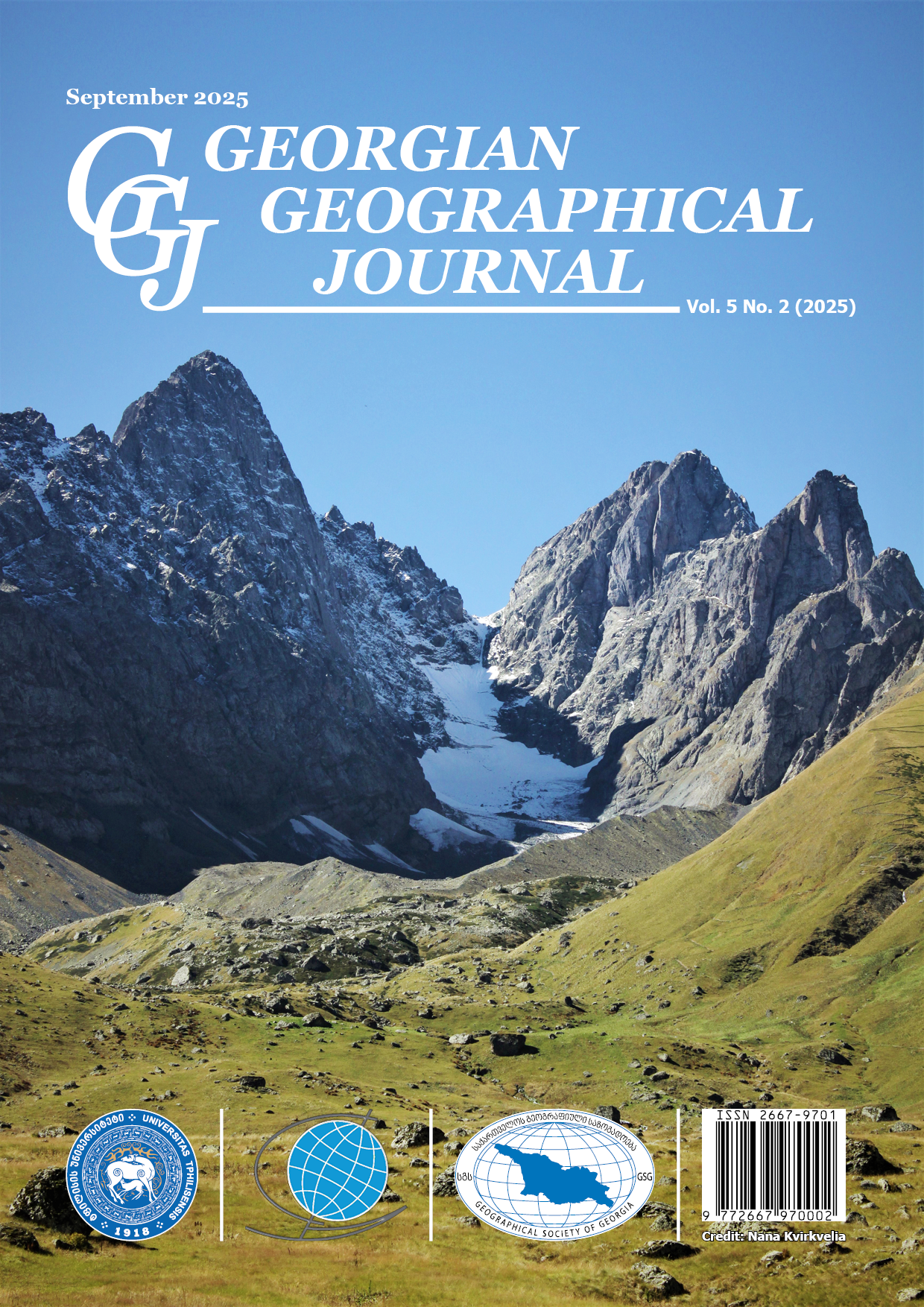
Upper Racha is among the most geologically and environmentally challenging regions of Georgia due to the frequency and intensity of exodynamic processes and the significant damage they inflict on the environment and local population. The southern slope of the Central Caucasus, encompassing the Shoda-Kedela and Lechkhumi ranges, is characterised by complex and diverse relief. The upper part of the territory lies within high-mountainous subalpine, alpine, and nival zones. The southern portion of Upper Racha is dominated by deeply incised erosional valleys of the Rioni River and its tributaries, with some valleys exhibiting incision depths exceeding 1,000 metres and slopes ranging between 40° and 60°. This erosional-denudation relief has developed on Jurassic sediments and is shaped by active exodynamic processes affecting strongly dislocated rocks of Liassic age. These processes give rise to a range of geomorphological phenomena, including erosion, riverine and lateral erosion, mudflows, landslides, rockfalls, and snow avalanches. The region’s high seismicity and abundant atmospheric precipitation further exacerbate these dynamics. A striking example of these processes occurred in late July 2023, when Upper Racha experienced alternating periods of extreme heat and torrential rainfall. Combined with the active ablation of the Buba Glacier, these conditions significantly increased the saturation of moraine material with liquid water, disrupting the gravitational stability of the slope. This triggered a catastrophic landslide that destroyed buildings at the Shovi resort, resulting in the tragic loss of 35 lives. This study aims to investigate the exodynamic processes in Upper Racha, identify their driving factors and development patterns, analyse the mechanisms behind such natural events, assess their impact on the formation and sustainability of the Shovi–Glola tourist hub, predict the future deve lopment of these processes, and propose effective preventive measures.
Downloads
References
Gavasheli, A. (1978). Upper Racha and its Natural Resources. 54.
Gongadze, M., Lominadze, G., Khomeriki, G., & Kavlashvili, G. (2024). Analysis of Spontaneous Exodynamic Processes in the Dghviora River Basin Taking into Consideration the Perspectives of the Shovi-Glola (Georgia) Tourist Agglomeration. Georgian Geographical Journal, 4(1), 26–34. https://doi.org/10.52340/ggj.2024.04.01.04
Nadareishvili, N., Tutberidze, M., Khomeriki, G., Dzhvarsheishvili, S., Kvirkvelia, N., Tchania, E., & Tavadze, G. (2025). Prospects of Tourism Development in Zemo Racha and Their Reflection Among the Local Society. Georgian Geographical Journal, 5(1), 63–73. https://doi.org/10.52340/ggj.2025.05.01.07
Elene Salukvadze. (2022). Environmental and Anthropogenic Factors in the Development of Geodynamical Processes in Racha. Georgian Geographical Journal, 2(1). https://doi.org/10.52340/ggj.2022.753
Tsereteli, E. e. (n.d.). Engineering and geological zoning of Georgia according to the degree of development of hazardous geological processes. Russian.
Downloads
Published
How to Cite
Issue
Section
License
Copyright (c) 2025 Georgian Geographical Journal

This work is licensed under a Creative Commons Attribution 4.0 International License.
This work is licensed under a CC BY Attribution



