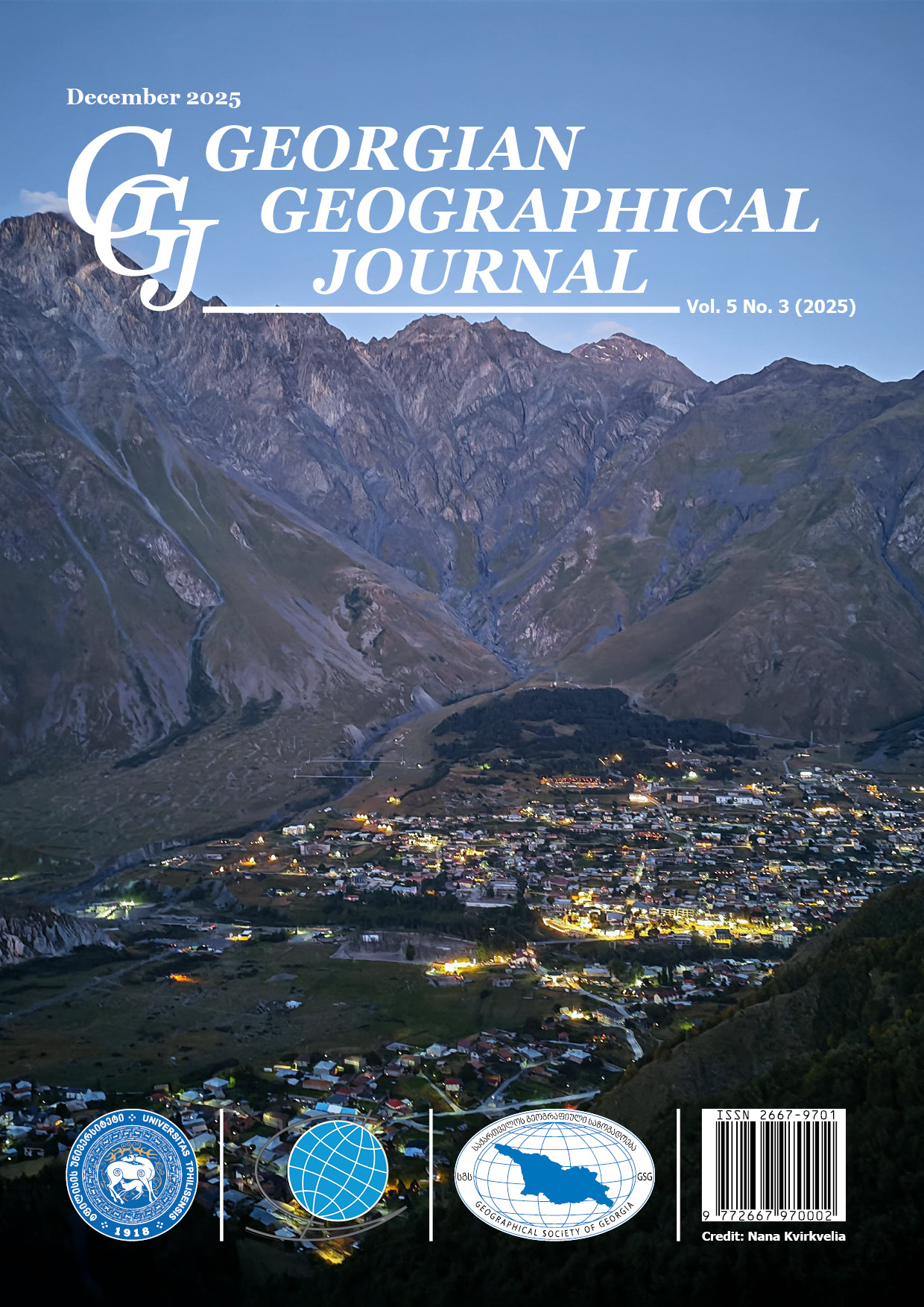
Svaneti at a Crossroads: Socio-Economic Challenges and Opportunities for Regional Development
DOI:
https://doi.org/10.52340/ggj.2025.05.03.08Keywords:
highland developments, socio-economic vulnerability, Mountainous Region, Svaneti, Agriculture, Migration, TourismAbstract
Svaneti, the most mountainous historical-geographical region of Georgia, is characterized by its exceptional natural conditions and culturally rich anthropogenic landscape. The region encompasses the municipalities of Mestia and Lentekhi, whose distinct physical environments, historical heritage, and socio-cultural traditions shape divergent trajectories of socio-economic development. In the summers of 2023–2024, a sociological survey was conducted within the framework of the Vakhushti Bagrationi Institute of Geography’s field expedition to evaluate contemporary socio-economic dynamics in the region through active engagement with local residents. A total of 35 respondents participated, enabling a comparative assessment between Mestia and Lentekhi and facilitating the identification of key development constraints and emerging opportunities. The survey was complemented by cartographic materials, statistical diagrams, and photographic documentation. The results reveal severe challenges related to depopulation, limited employment opportunities, and pronounced out-migration—issues particularly acute in Lentekhi, where sustained emigration has resulted in the closure of kindergartens and schools in several villages. Although livestock breeding continues to represent a traditional economic activity, tourism has become an increasingly important sector, with a majority of respondents expressing interest in acquiring the skills necessary to participate more effectively in tourism-related services. Nevertheless, infrastructure remains unevenly developed: while major transportation corridors have been improved, rural road networks require substantial reconstruction, and deficiencies persist in telecommunications, healthcare provision, and commercial services. Tourism infrastructure, including accommodation facilities and visitor information centres, also remains insufficient and requires systematic, state-supported development. The analysis further indicates that migration pressures are more pronounced in Lentekhi than in Mestia, driven by a complex interplay of economic, infrastructural, and demographic factors. Addressing these challenges will require integrated regional policies aimed at strengthening population retention, diversifying employment, and balancing tourism-driven growth with the needs of agriculture and traditional livelihoods. Given the limited availability of arable land and other natural constraints, sustainable development in Svaneti cannot rely solely on agriculture; instead, it must be underpinned by targeted job creation, improved infrastructure, and enhanced state involvement across multiple sectors.
Downloads
References
Bernard, H. R. (2017). Research methods in anthropology: Qualitative and quantitative approaches (6th ed.). Rowman & Littlefield.
Beniston, M. (2003). Climate change in mountain regions: A review of possible impacts. Climatic Change, 59(1–2), 5–31. https://doi.org/10.1023/A:1024458411589
Bryman, A. (2016). Social research methods (5th ed.). Oxford University Press.
Creswell, J. W. (2014). Research design: Qualitative, quantitative, and mixed methods approaches. Sage Publications.
Debarbieux, B., & Rudaz, G. (2015). The mountain: A political history from the Enlightenment to the present. University of Chicago Press.
Food and Agriculture Organization. (2015). Mapping the vulnerability of mountain peoples to food insecurity. FAO.
Gogorishvili, I., & Zarandia, E. (2021). Expansion of capacity development of local self-government in Georgia. Estonian Discussions on Economic Policy, 29(12). https://doi.org/10.33422/iarmea.2018.09.22
Ivasciuc, I. S., & Ispas, A. (2023). Exploring the motivations, abilities and opportunities of young entrepreneurs to engage in sustainable tourism business in the mountain area. Sustainability, 15(3). https://doi.org/10.3390/su15031956
Jodha, N. S. (2005). Adaptation strategies against growing environmental and social vulnerabilities in mountain areas. Mountain Research and Development, 25(1), 14–18. https://doi.org/10.1659/0276-4741(2005)025[0014:ASAGEA]2.0.CO;2
Khazaradze, R., & Salukvadze, E. (2024). The potential of the Central Caucasus passes for the development of mountain tourism and alpinism. Science and Technologies, 1(741), 21–30. (In Georgian).
Khartishvili, L., Muhar, A., Dax, T., & Khelashvili, I. (2019). Rural tourism in Georgia in transition: Challenges for regional sustainability. Sustainability, 11(2), 410. https://doi.org/10.3390/su11020410
Longley, P. A., Goodchild, M. F., Maguire, D. J., & Rhind, D. W. (2015). Geographic information systems and science. John Wiley & Sons.
MacDonald, D., Crabtree, J. R., Wiesinger, G., Dax, T., Stamou, N., Fleury, P., Gutierrez Lazpita, J., & Gibon, A. (2000). Agricultural abandonment in mountain areas of Europe: Environmental consequences and policy response. Journal of Environmental Management, 59(1), 47–69. https://doi.org/10.1006/jema.1999.0335
Messerli, B., & Ives, J. D. (1997). Mountains of the world: A global priority. Parthenon Publishing.
Moretti, M., Belliggiano, A., Grando, S., Felici, F., Scotti, I., Ievoli, C., Blackstock, K., Delgado-Serrano, M. M., & Brunori, G. (2023). Characterizing value chains’ contribution to resilient and sustainable development in European mountain areas. Journal of Rural Studies, 100. https://doi.org/10.1016/j.jrurstud.2023.103022
Salukvadze, E., & Chaladze, T. (2025). Main geographical factors of settlement patterns and natural resource use in mountain regions: The Kvemo (Lower) Svaneti (Lentekhi Municipality) case. Georgian Geographical Journal, 5(1), 31–40. https://doi.org/10.52340/ggj.2025.05.01.04
Salukvadze, G. (2022). Geographical and sectoral aspects of the interrelationship between tourism and other economic sectors: The example of the mountainous regions of Georgia (Doctoral dissertation, TSU). NPLG Repository. https://dspace.nplg.gov.ge/bitstream/1234/541818/1/Saluqvadze_Gvantsa_Disertacia.pdf
Sharia, M. (2019). Analyzing tourism influence on agricultural products’ market: A case study of the Mestia Municipality, Georgia. Ankara Üniversitesi Çevrebilimleri Dergisi, 7(2), 98–105. https://dergipark.org.tr/tr/pub/aucevrebilim/issue/51058/618269
Organisation for Economic Co-operation and Development (OECD). (2020). A territorial approach to the Sustainable Development Goals: Synthesis report. OECD Publishing. https://doi.org/10.1787/e86fa715-en
Pfeffer, K., Baud, I., Denis, E., Scott, D., & Sydenstricker-Neto, J. (2005). Participatory spatial knowledge management tools. Information, Communication & Society, 8(1), 72–100.
Price, M. F. (2013). Mountain geography: Physical and human dimensions. University of California Press.
Ray, C. (1998). Culture, intellectual property and territorial rural development. Sociologia Ruralis, 38(1), 3–20. https://doi.org/10.1111/1467-9523.00061
Vasadze, M., & Ositashvili, N. (2021). Socio-economic impact on sustainable mountain tourism of Georgia. World Science, 4(65). https://doi.org/10.31435/rsglobal_ws/30042021/7542
United Nations Environment Programme (UNEP). (2012). Mountain ecosystems. UNEP. https://wedocs.unep.org/20.500.11822/8693. (official UNEP publication link)
United Nations Economic Commission for Europe. (2019). Sustainable development in mountain regions of the Caucasus. UNECE.
Yin, R. K. (2018). Case study research and applications: Design and methods (6th ed.). Sage Publications.
Downloads
Published
How to Cite
Issue
Section
License
Copyright (c) 2025 Georgian Geographical Journal

This work is licensed under a Creative Commons Attribution 4.0 International License.
This work is licensed under a CC BY Attribution



