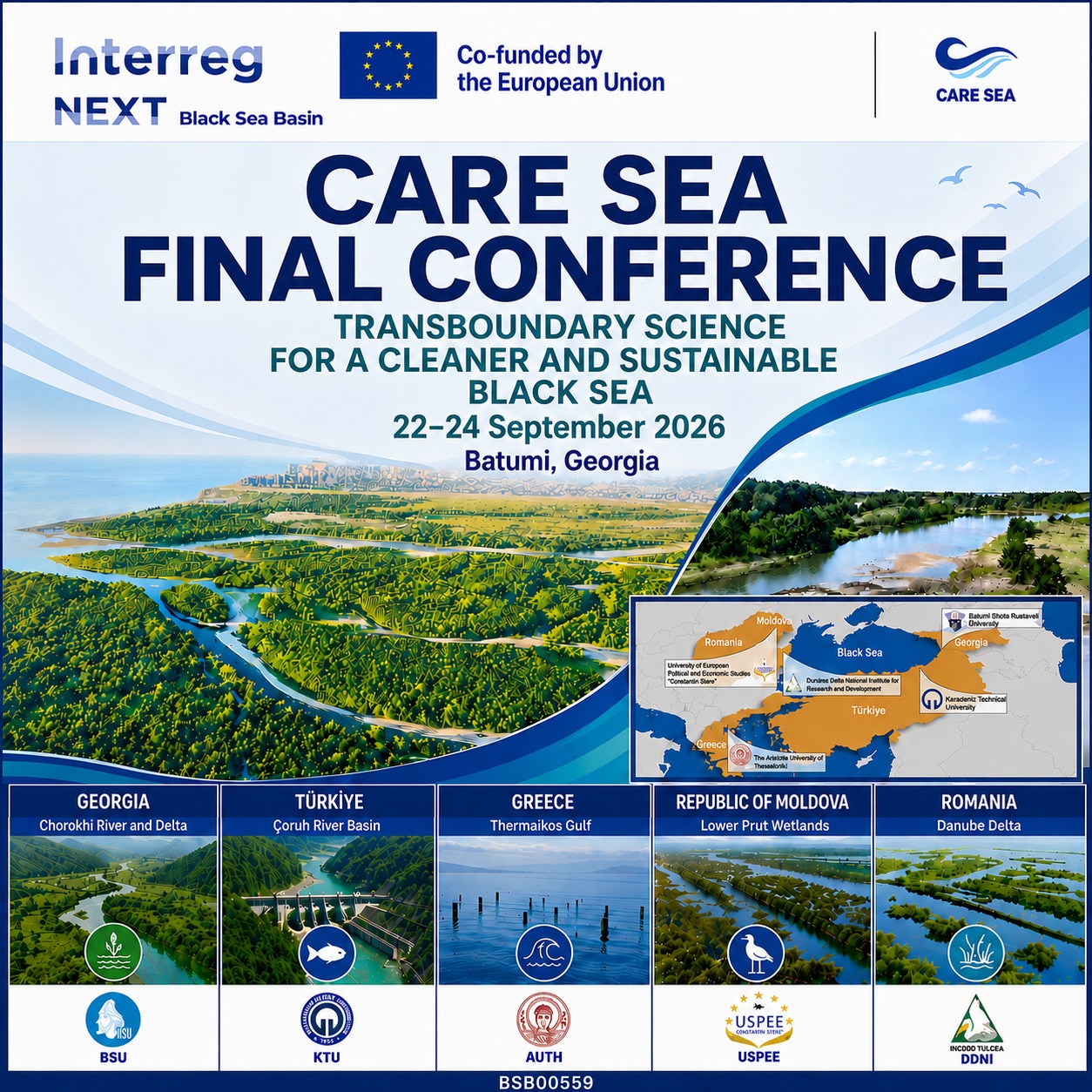
Distribution Dynamics of Three Invasive Alien Plant Species (Sicyos angulatus, Verbena brasiliensis and Ambrosia artemisiifolia) in Relation to Vegetation Structure and Floristic Composition in the Chorokhi Delta, Western Georgia/Sakartvelo
Keywords:
Chorokhi Delta, invasive alien plants, floristic composition, vegetation structure, distribution dynamicsAbstract
The Chorokhi Delta, part of the Emerald Network and an Important Bird and Biodiversity Area (IBA), is subject to anthropogenic pressure and the spread of invasive alien plant species. This study aimed to document the distribution patterns of Ambrosia artemisiifolia, Sicyos angulatus and Verbena brasiliensis and assess their occurrence in relation to vegetation structure and floristic composition in disturbed secondary habitats of the Chorokhi Delta, western Georgia.
Field surveys were conducted in 2025 and 2026 using repeated monitoring of established transects and sampling quadrats. Transects occupied by the target species were compared with reference transects where their occurrence was initially absent or relatively limited. Plant species composition and vegetation cover were recorded using the Braun Blanquet method, and changes between monitoring years were assessed.
The results revealed differences in the distribution patterns of the three target species and substantial representation of alien plants in the surveyed vegetation. In the Sicyos angulatus transects, 53 plant species belonging to 24 families were recorded across both transects, including 28 alien species. The species climbed over alder (Alnus glutinosa subsp. Barbata) trees and spread across their crowns, while its occurrence in the reference transect increased from two quadrats in 2025 to six in 2026. In the Ambrosia artemisiifolia study area, the number of recorded species increased from 51 in 2025 to 54 in 2026. The species spread into the transect where it had initially been absent and was recorded in all 15 quadrats in 2026. In the Verbena brasiliensis transects, the overall floristic composition remained stable between monitoring years, with 65 species belonging to 28 families recorded. However, the spatial distribution of some accompanying alien species changed, and increased abundance and cover of A. artemisiifolia and Microstegium japonicum were observed in both transects.
The findings demonstrate that changes associated with invasive plant species in the Chorokhi Delta can be reflected in their spatial distribution, abundance, cover and relationships with vegetation structure, even where overall floristic composition remains stable. Continued monitoring of the same transects and sampling quadrats is important for assessing longer-term distribution trends and associated changes in plant communities.
Downloads
References
1. Archuadze M, Arveladze T, Basilashvili KH, Bubashvili T, Bu¬daghashvili N, Gurgenidze Z, Mikeladze A, Khokhiashvili L, Chikorashvili G, Jhavakhishvili N. (2021). Chorokho Delta (GE0000054) emerald area management plan. Tbilisi. https:// www.sabuko.org/wp-content/uploads/2021/12/tchorokhis -deltis-zurmukhtis-teritoriis-marthvis-gegma.pdf.
2. Blanquet JB, Fuller GD, Conard HSh (1932) Plant Sociology: The Study of Plant Commu¬nities. Authorized English Translation of Pflanzensoziologie, 471 pp.
3. Davitadze M (2001). Adventive Flora of Adjara. Batumi, 198 pp.
4. Evans D, Roekaerts M, Cuhna A, Parry M, Williams J, Wright H (2019) Convention on the conservation of European wildlife and Natural habitats. Strasbourg, T-PVS/PA 6: 1–10. https:// rm.coe.int/addition-of-marine-habitats-to-resolution-no-4 -1996-/168097199c.
5. Kolakovskii A. Flora abkhazii, vol. IV, 1986, pp. 92-94. Tbilisi.
6. Mikeladze I, Manvelidze Z, Tsiskaridze D, Shainidze G. (2023). Distribution and inva¬siveness of four non-native species of plants in ecosystems in Chorokhi Delta (SW GEORGIA). European Journal of Environmental Sciences 13(2): 80–89. https://doi. org/10.14712/23361964.2023.9
7. Mikeladze I., Tsiskaridze D., Manvelidze Z., Shainidze G. Distribution and invasiveness of some invasive alien species (IAS) of plants in ecosystems of Colchis lowland (W Georgia / Sakartvelo). 2025. Scientific Annals of the Danube Delta Institute 30: 91–106 (2025). DOI: 10.3897/saddi.30.165717 . https://saddi.pensoft.net/article/165717/
8. Mikeladze I., Bolkvadze G., Metreveli M., Chagalidze R., Davitadze M. Sicyos angulatus L. new Alien Species in Souhtern Colkheti Flora. // Biological Forum-An International Journal. Print ISSN 0975-1130, Online ISSN NO.2249-3239). VOL 7(2) 2015. 266-268.
9. Mikeladze I. Bolkvadze G. New distribution records of the alien plant – Sicyos angulatus L. (Cucurbitaceae) from Georgia. Caucasiana 2, 2023, 9-13. ISSN 2667-9809 (online). https://doi.org/10.3897/caucasiana.2.e96039 Paposhvili N, Ninua L, Dekanoidze D, Temur Shvelidze T, Janiash¬vili Z, Javakhishvili Z (2016) Special Protection Areas (SPA) for birds in Georgia. (GIZ; Ilia state university) Tbilisi. http://aves .biodiversity-georgia.net/spa-n-15/.
10. Mikeladze I., Bolkvadze G., Metreveli M., Chagalidze R., Davitadze M., Sharabidze A. Brasilien Vervain (Verbena Brasiliensis) in Colkheti Flora. Volume 15, Issue 2, June 2017, Pages 198–200. https://doi.org/10.1016/j.aasci.2017.05.013
11. Richardson D, Pyšek P, Rejmanek M, Barbour M, Paneta F, West C (2000) Naturalization and invasion of alien plants: concepts and definitions. Divers Distrib 6: 93–107.
12. Simberloff D. (2013). Invasive species-what everyone needs to know. Oxford University Press, New York.
13. Verlove F. Verbena brasiliensis (verbenaceae), a new record for the flora of Georgia (former Ussr), Syst. Geogr. (2006) 185-189.